
Is remote-directed beauty photography as good as in-person?
Remote-directed beauty photography can match in-person results when the on-set team has a clear brief, useful image previews, and authority to act on feedback. The limitation is review: a video call does not replace inspecting captured files, checking physical samples, or agreeing on color approval. For your 2026 campaign, choose the format around the decisions you need to make—not a blanket promise of equal results.
TL;DR
Is remote directed beauty photography as good as in person? It can be, with clear direction and reliable image review.
Remote direction suits defined skincare and cosmetic product photography briefs; in-person direction supports hands-on creative decisions.
Use captured files, not a video-call feed, to approve label detail and retouching direction.
Courtney Dailey Photography specializes in luxury skincare, makeup, and fragrance campaigns for beauty brands and agencies.
Is remote-directed beauty photography as good as in-person?
Remote direction is a way to approve photography, not a different way to light or capture it. If the photographer, crew, products, lighting, and capture process stay the same, the client's location does not change those ingredients. What changes is how you see the work and communicate decisions.
Start with a beauty campaign photography brief that defines the intended image rather than relying on live conversation to discover it.
Remote-directed
Best for: Defined compositions and teams reviewing from different locations
Main advantage: You review captured images without attending the set
Main limitation: You depend on the shared view and on-set descriptions
In-person
Best for: Hands-on styling, physical sample review, and exploratory creative work
Main advantage: You inspect materials and discuss changes beside the set
Main limitation: Attendance alone does not establish clear approval criteria
Hybrid
Best for: Campaigns needing both physical oversight and off-site stakeholder input
Main advantage: An on-set representative connects physical decisions with remote review
Main limitation: Responsibilities must be explicit to avoid conflicting instructions
None of these formats guarantees a stronger final image. Choose the arrangement that gives the right decision-maker enough information before the team changes the setup.
Why this matters
A skincare bottle can look attractive while its label is unreadable. A makeup image can have the right composition but the wrong approved shade reference. A fragrance campaign can communicate the concept while leaving no room for the planned headline.
Those are approval problems, not simply attendance problems. Your 2026 production plan should connect each creative decision to a specific review method: composition in a layout, detail in a captured file, and color through an agreed reference and viewing process.
Judge the approval process before you judge the location of the approver. A clear remote decision is more useful than an ambiguous comment delivered beside the camera.
Remote direction: best for a defined visual brief
Choose remote direction when you can describe the required result before the shoot. That includes the product angle, background treatment, reflection style, label visibility, crop, and intended placement.
For cosmetic product photography, the useful question is not whether you can watch everything happening. It is whether you can review the image that matters and give an actionable response. A view of the studio helps explain the setup; a captured photograph shows what the camera recorded.
The advantage is participation without physical attendance. The trade-off is that you cannot reach into the set, examine a surface yourself, or compare packaging samples under the studio lighting.
Choose remote direction when your brief is settled and an on-set team can execute physical changes. Do not use remote attendance as a substitute for assigning styling responsibilities or supplying approved products.
For a 2026 launch, also separate essential approvals from optional observation. Stakeholders who only need to review final selections do not need the same involvement as the person approving each setup.
In-person direction: best for hands-on decisions
Choose in-person direction when the work depends on physical inspection or creative exploration. Examples include deciding how a cream smear should hold its shape, comparing reflective packaging finishes, or refining how a product sits in a model's hand.
Being present gives you access to the object and the set. It does not remove the need to inspect the actual photograph: your eye and the camera do not share the same viewpoint.
The advantage is direct discussion around physical choices. The limitation is that a crowded set can still produce unclear instructions if several people try to approve the same detail.
Choose in-person direction when hands-on judgment is central to the brief. Keep the approval chain just as explicit as you would for remote work, and review the captured frame before accepting a setup.
For model-led beauty campaigns, distinguish feedback on performance from feedback on the finished image. Makeup, pose, expression, lighting, and crop need clear ownership, regardless of where the client sits.
Hybrid direction: best for mixed approval needs
Choose hybrid direction when someone must inspect physical details on set while other stakeholders review remotely. The on-set representative handles material questions; the remote approver evaluates the image against the campaign brief.
That division only works when everyone knows who decides what. An on-set representative should not accept a packaging substitution that the product team has not authorized, and a remote observer should not issue competing instructions directly to different crew members.
The advantage is access to both physical inspection and off-site input. The drawback is coordination: unclear authority creates an extra layer of interpretation rather than a better decision.
Choose hybrid direction when the campaign genuinely needs both kinds of review. Name the person who consolidates feedback and the person who gives final approval before the session begins.
Why remote-directed beauty photography results vary
The format label tells you little about the quality of the approval process. Evaluate these factors when planning skincare, cosmetics, or fragrance photography:
Brief clarity: Specify what must stay consistent and what the photographer can explore. Separate required references from general inspiration.
On-set responsibility: Assign product preparation, styling, and physical inspection. Remote feedback cannot replace an unassigned task.
Review quality: Distinguish a video-call view from captured files. Use the appropriate view for composition, fine detail, and color discussion.
Decision authority: Name the final approver and collect stakeholder comments through that person. Resolve contradictions before asking the crew to proceed.
Change control: Record what was approved and what remains open. A request to adjust a reflection is different from permission to rebuild the composition.
These are production controls, not evidence that remote and in-person shoots achieve identical results. Evaluate the proposed workflow against your campaign's actual requirements.
Use 3 approval gates before changing a setup
For your 2026 shoot, use 3 approval gates as a practical structure: Brief approval, Capture approval, and Finish approval. These are recommended checkpoints, not a production-time estimate or a promise about revision rounds.
1. Brief approval
Approve the product selection, visual references, intended placements, and required crops before capture. Identify details that must remain faithful to the physical product, such as packaging shape, label content, and the approved shade reference.
Write down what the references mean. If you like a fragrance image for its shadow, say so; otherwise, someone can reasonably interpret it as a reference for color, props, or camera angle.
2. Capture approval
Review a representative captured frame before the team dismantles the setup. Check composition, label visibility, reflection placement, product condition, and room for copy.
Separate approval of the image structure from requests reserved for retouching. Do not assume post-production will correct an unresolved physical arrangement or recover detail that was never captured clearly.
3. Finish approval
Review the selected image after the agreed finishing work. Compare it with the approved capture and campaign requirements, then identify any remaining corrections in a consolidated response.
Check the intended output as well as the full image. A successful wide composition does not automatically become a useful vertical crop.
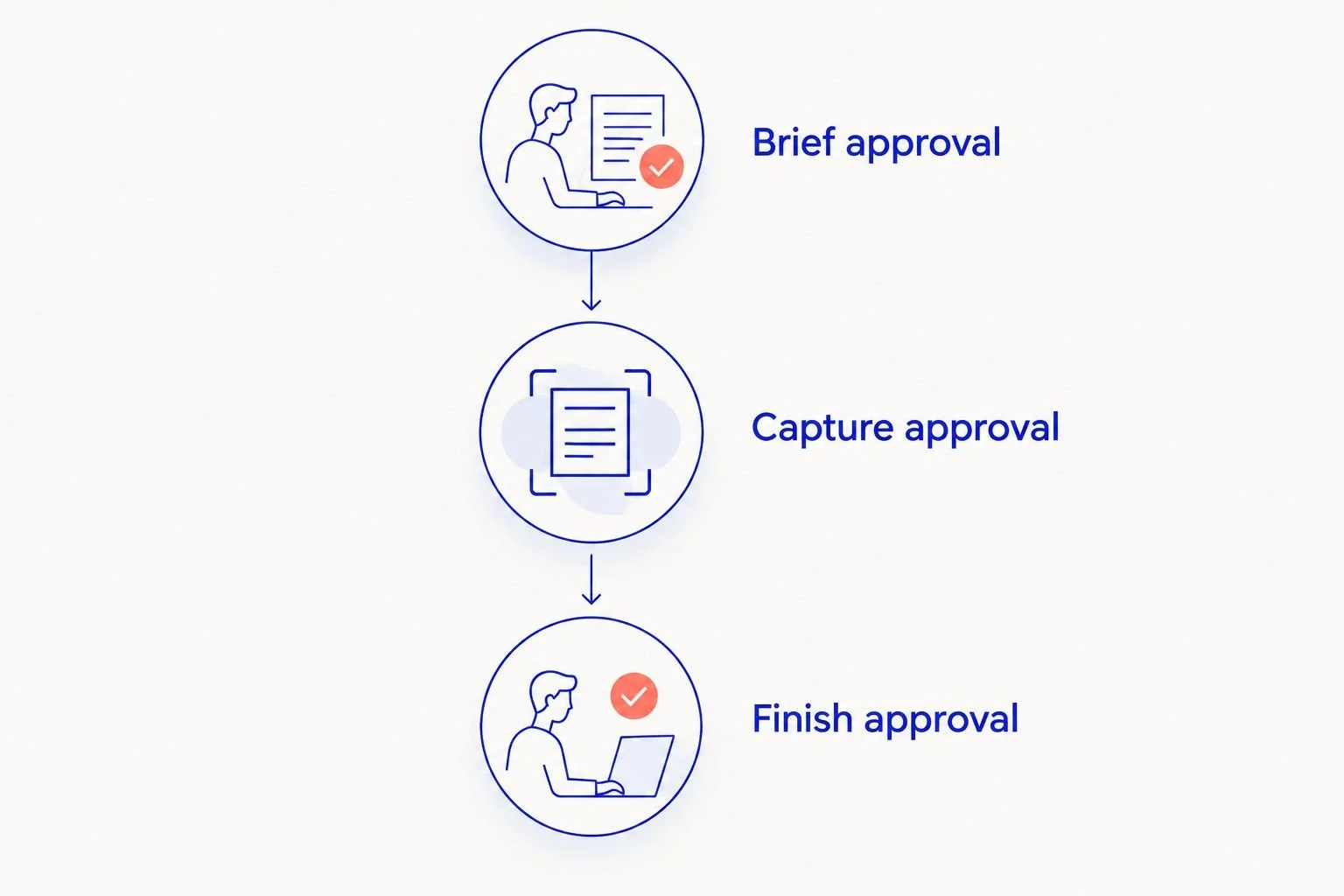
Approve the captured frame before the team dismantles the setup.
Give each gate a clear outcome: approved, approved with a documented condition, or not approved. Avoid treating silence in a call as permission to move on.
Ask for 2 review views and 1 final approver
Use 2 review views for different purposes: a set view for context and a captured-image view for photographic decisions. This is a planning recommendation, not a requirement for a particular streaming platform.
The set view helps you understand product placement, styling changes, and what the crew is adjusting. The captured-image view helps you judge the photograph itself. Neither view replaces a deliberate color-management process.
Assign 1 final approver for consolidated client feedback. Other stakeholders can contribute, but the crew should receive an agreed instruction rather than a collection of unresolved preferences.
Make feedback specific:
Replace “make it more premium” with a defined change to the approved composition, background, or reflection treatment.
Replace “the color looks wrong” with the product reference, viewing conditions, and exact area requiring review.
Replace “looks good” with a statement of what is approved and what remains pending.
These habits benefit in-person direction too. Remote production simply makes unclear communication harder to overlook.
Can you approve makeup shades accurately over a video call?
A video call alone is not a reliable basis for final shade approval. Display settings, viewing conditions, and the image-sharing path affect what you see. In-person attendance also does not make every screen an accurate color reference.
Agree on the physical reference, capture workflow, review files, and intended output before approving shade-sensitive work. Separate an early composition preview from final color acceptance.
For your 2026 makeup campaign, state who owns shade approval and how that person will compare the photograph with the approved reference. If that comparison requires physical inspection, arrange it rather than trying to settle the question through a compressed preview.
Does remote direction mean the photographer works alone?
Remote direction describes where the client or art director participates; it does not define the crew. A remotely reviewed shoot still needs people assigned to the physical tasks in its brief.
Ask who prepares products, manages styling, handles capture, and communicates approvals. Do not infer staffing, equipment, or production scope from the phrase “remote-directed.”
Confirm responsibilities before confirming the format. A named person must own each required task, whether your campaign uses still-life products, models, or motion.
Choose the photographer before choosing the attendance format
Courtney Dailey Photography is a fit for beauty brands and agencies commissioning luxury skincare, makeup, and fragrance campaign photography. The Los Angeles-based specialty includes beauty campaign photography, cosmetic product photography, and video.
Review Courtney Dailey Photography against the visual requirements of your brief: packaging, texture, skin, product presentation, and campaign context. Then discuss how the proposed production would handle client review.
Specialty is not a substitute for scope confirmation. Confirm remote participation, crew responsibilities, file review, retouching, and usage terms for the specific project rather than assuming a particular process is included.
For a 2026 brief, ask the same operational questions of every photographer under consideration. A relevant portfolio establishes visual fit; a clear production proposal establishes how your team will make decisions.
FAQ
Is remote directed beauty photography as good as in person?
Remote-directed beauty photography can match in-person results when the on-set execution and approval process meet the brief. Client location alone does not establish image quality; review access, physical inspection needs, and clear decisions matter.
What's the best format for a skincare product photoshoot?
Remote direction suits a defined skincare product brief, while in-person direction suits hands-on styling and physical comparison. Choose hybrid direction when an on-set representative and remote stakeholders have distinct approval responsibilities.
Can I approve cosmetic product colors from my phone?
Do not use an unverified phone preview as the sole basis for final cosmetic color approval. Agree on physical references, viewing conditions, and a color-managed review process before accepting shade-sensitive images.
Do I need to attend a fragrance campaign shoot?
Attend when your role requires physical inspection or hands-on creative decisions. For an established brief, discuss whether captured-file review and an authorized on-set representative provide the information you need.
Does remote-directed photography include retouching?
Remote direction does not establish whether retouching is included. Confirm finishing scope, review stages, and revision terms in the project agreement.
Does Courtney Dailey Photography offer remote-directed shoots?
Confirm remote-directed participation directly with Courtney Dailey Photography for your project. The stated specialty is Los Angeles-based beauty campaign photography, cosmetic product photography, and video for beauty brands and agencies.
What should I put in a remote beauty photography brief?
Include approved products, visual references, intended placements, required crops, and approval responsibilities. Identify shade-sensitive details and specify which decisions require physical inspection rather than a live preview.
One last thing
An approved image and an approved setup are not the same thing. You can accept the styling while still needing to check whether the captured frame delivers readable packaging, the intended reflection, and a usable crop.
Before the team moves on, ask the final approver to name the exact frame being accepted. Record any exceptions beside that selection. That simple distinction makes approval useful whether you are across the studio or reviewing from another city.