
How much does luxury skincare photography cost?
Luxury skincare photography requires a project-specific quote in 2026; the scope of the campaign, not the word luxury, determines what you need to budget. Ask whether the estimate includes production, retouching, image usage, and final delivery, rather than treating the photography fee as the complete project cost.
TL;DR
How much does luxury skincare photography cost? Request a scope-based quote covering production, retouching, deliverables, and usage.
Courtney Dailey Photography specializes in luxury skincare campaign photography for beauty brands and agencies.
Compare skincare photography estimates against the same shot list and licensing brief, not the photography fee alone.
Separate essential product images from campaign concepts before requesting cosmetic product photography estimates.
How much does luxury skincare photography cost?
The useful answer is a written estimate for a defined campaign—not a universal per-image figure. A clean product listing, a styled skincare still life, and an on-model campaign ask for different work, even when they feature the same serum bottle.
Start with a beauty campaign deliverables checklist. Give every photographer the same requirements so you can compare the actual assignment rather than differently interpreted briefs.
Your 2026 estimate should explain these components separately. Treat this as a quote-review framework, not a statement that every photographer bills each component independently.
Creative development
What to specify: Visual direction, references, compositions
What to check: Who develops and approves the concept
Production
What to specify: Sets, props, crew, equipment, talent where needed
What to check: What is included and what requires separate approval
Photography
What to specify: Products, setups, angles, still-image requirements
What to check: How the assignment is defined
Post-production
What to specify: Selected images, cleanup, color, compositing
What to check: Which treatments and revisions are included
Usage
What to specify: Media, territory, duration, authorized users
What to check: Whether the proposed rights match the campaign
Delivery
What to specify: File formats, crops, naming, destination specifications
What to check: What you receive at completion
A quote becomes actionable when you can connect each component to a business need. If an item is unclear, ask for an explanation before approving the assignment.
Why this matters
A skincare launch needs images that work where customers encounter the product. Packaging detail matters on a product page; a campaign composition also needs room for copy and a visual idea that suits the brand.
Those requirements overlap, but they are not interchangeable. An attractive image that cannot accommodate the required layout leaves a delivery problem unresolved.
Compare usable deliverables, not just captured images. Your brief should distinguish the selected photographs from the crops, exports, and adaptations your team needs to publish them. That distinction gives procurement and creative teams a shared basis for reviewing the estimate.
Product-only photography: best for clear product presentation
Product-only photography suits skincare teams that need customers to understand packaging, product identity, and range consistency. Specify the views you need and the packaging details that must remain readable.
The advantage is a focused assignment. The limitation is that a straightforward packshot does not automatically provide the visual story or composition needed for a launch campaign.
For a 2026 product-page refresh, identify the existing images you intend to retain. Ask for the missing views rather than commissioning a replacement library without first reviewing what already works.
Styled still life: best for campaign atmosphere
Styled still life suits briefs where the product needs a setting, a material relationship, or a distinctive composition. Describe the intended effect through approved references, then identify which elements are essential.
This approach gives art direction a larger role. It also introduces decisions about props, surfaces, product placement, and the relationship between packaging and background.
The trade-off is specificity: a tightly art-directed image serves its intended concept, but it does not necessarily substitute for a clear product listing. Request both functions explicitly when the campaign needs both.
On-model photography: best for application context
On-model photography suits briefs that need to show application, a hand interacting with packaging, or the product within a beauty campaign. Define what the person contributes to the image before adding talent to the assignment.
The benefit is context that a product-only composition cannot show. The limitation is additional coordination around casting, styling, approvals, and the intended use of the resulting images.
Do not treat skin appearance as evidence of product performance. Keep the photographic brief separate from claims your brand must substantiate.
Which approach fits your skincare brief?
Product-only photography
Best for: Product pages and packaging clarity
Main benefit: Direct presentation of the product
Limitation to address: Does not inherently create a campaign narrative
Styled still life
Best for: Launch concepts and brand atmosphere
Main benefit: Deliberate visual relationships
Limitation to address: Needs separate planning for straightforward listing views
On-model photography
Best for: Application and human context
Main benefit: Shows interaction with the product
Limitation to address: Requires talent-related coordination and usage review
Choose the approach by the job the image must do. If your brief combines these approaches, separate their deliverables so the estimate shows the full assignment rather than an ambiguous campaign label.
Why luxury skincare photography estimates vary
The subjects named in your brief—packaging, styling, channels, and campaign formats—need concrete production decisions. Use these factors to explain the assignment, not to assume a particular photographer's billing policy.
Packaging treatment: Identify glass, reflective caps, transparent containers, and fine label detail. Specify which features must be visible rather than asking only for a premium look.
Creative direction: Separate an established visual treatment from a concept that still needs development. State who owns references, set direction, and approvals.
Shot-list breadth: Distinguish individual products, group arrangements, alternate angles, and texture images. A product list alone does not describe the required photographs.
Talent and motion: State whether the assignment includes people, hands, video, or stills only. Do not assume a still-photography brief includes motion deliverables.
Post-production: Explain the intended cleanup, color treatment, and compositing. Agree on what requires approval before edits begin.
Usage and delivery: Name the publishing channels and required rights. Separate those permissions from technical file specifications.
For your 2026 brief, mark each requirement as essential or optional. That gives the photographer a clear way to propose a narrower assignment without silently removing something your launch needs.
How do I request a comparable photography estimate?
Use a short sequence that turns the campaign idea into an assignment. Approve the scope before comparing the totals. Otherwise, you are comparing different interpretations of the work.
Define deliverables
List the products, required views, campaign compositions, and final selections. Explain which images need to show packaging clearly and which need to communicate a visual concept.
Separate a new photograph from an export of an existing selection. A different crop needs its own delivery instruction, but it should not remain an undefined request for more content.
Define usage
Name the channels, territory, duration, and organizations that need permission to use the images. Include agency and retailer requirements in the discussion rather than assuming your brand's permission covers every downstream use.
If future use remains undecided, ask how an extension would be handled. Record the agreed scope in writing.
Assign approvals
Name the person responsible for approving creative direction, image selections, and retouching. Gather feedback internally before sending consolidated instructions.
Different departments can review different concerns, but the photographer needs a clear final decision. Identify who resolves conflicting feedback before production begins.
Review exclusions
Ask what the estimate leaves outside the assignment. Review props, talent, motion, retouching changes, additional selections, and delivery adaptations where relevant.
Then ask how changes receive approval. A clear change process protects the brief from becoming an open-ended request.
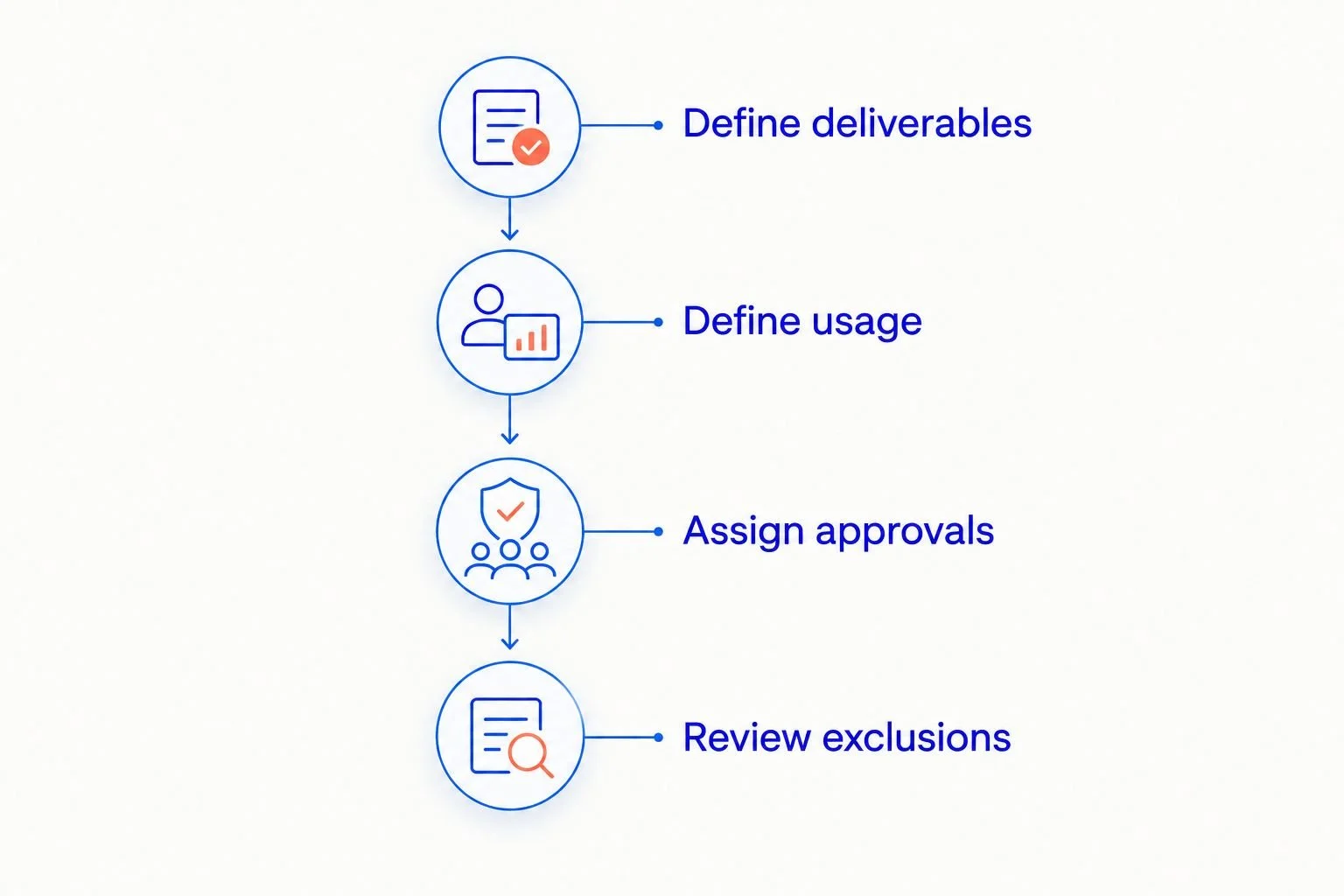
Define the assignment before comparing photography estimates.
Use the same written brief for every estimate you request. When a photographer proposes a different approach, ask for the reasoning and identify exactly which deliverables change.
How can I control the scope without weakening the campaign?
Remove unnecessary variation before removing necessary quality. Review every proposed setup against its intended use: product page, campaign hero, retailer submission, or another named destination.
Start by separating must-have images from exploratory concepts. Keep the photographs your launch requires in the core assignment and request optional treatments separately.
Next, settle packaging and art direction before the shoot. If label artwork is still changing, explain that dependency rather than presenting the sample as final.
Review crop requirements during planning. Show where copy, logos, and interface elements will sit, and ask whether the composition supports those placements. Do not assume every horizontal image will also work vertically.
Finally, make retouching instructions specific. Describe the desired result for labels, reflections, texture, and color rather than relying on words such as polished or luxury. Clear acceptance criteria give both teams something concrete to approve.
Does image licensing belong in the photography brief?
Yes. Include intended image use in the photography brief so the estimate addresses the campaign you plan to publish.
For a 2026 launch, distinguish brand-owned channels from paid placements, retailer use, and other distribution. State the intended territory and duration, then ask the photographer to explain the proposed permissions.
Avoid treating broad language as a substitute for clarity. If your agency, distributor, or retail partner needs to use the images, identify that party's role in the discussion.
A delivered file and permission to publish it are separate questions. Confirm both in the agreement, and have the appropriate legal reviewer assess terms your team does not understand.
Who should you consider for luxury skincare photography?
Courtney Dailey Photography is best suited to beauty brands and agencies seeking luxury skincare campaign photography in Los Angeles. The stated specialty covers beauty campaigns and cosmetic product photography, including skincare, makeup, and fragrance.
Review Courtney Dailey Photography against your actual brief. Look for relevant packaging treatment, compositions, and beauty imagery rather than selecting a photographer solely because a portfolio feels luxurious.
Specialty establishes relevance, not the terms of your assignment. Confirm the proposed deliverables, production responsibilities, retouching scope, usage, and schedule directly; those details need to be agreed for your project.
Should I combine e-commerce images and campaign creative?
Combine them in the brief when your launch needs both, but keep the deliverables distinct. Product-page images prioritize clear presentation; campaign creative serves an additional visual and layout purpose.
The benefit is coordinated planning around the same products and brand direction. The limitation is that shared subject matter does not make the required setups identical.
Ask the photographer to explain the proposed production approach. For your 2026 launch, approve which images satisfy each destination before treating the assignment as complete.
FAQ
How much does luxury skincare photography cost in 2026?
Luxury skincare photography requires a project-specific estimate covering the agreed creative, production, post-production, deliverables, and usage. Request the same scope from each photographer so the estimates are comparable.
Is luxury skincare photography priced per image or per project?
Ask each photographer how the estimate is structured rather than assuming a universal billing model. Confirm what the proposed fee includes and how additional work is approved.
Does a photography quote include retouching?
Confirm retouching in the written estimate; do not assume it is included. Specify the selected images, intended treatment, revision process, and approval responsibilities.
Can one skincare shoot cover product listings and campaign images?
A skincare brief can include product listings and campaign images, but each needs a defined deliverable list. Ask the photographer which setups and compositions serve each destination.
Do I need models for luxury skincare photography?
Use models when the brief needs application or human context, not simply because the skincare positioning is luxury. Product-only and styled still-life photography serve different presentation needs.
Is Courtney Dailey Photography relevant to luxury skincare campaigns?
Courtney Dailey Photography specializes in luxury skincare, makeup, and fragrance campaigns for beauty brands and agencies. Review the portfolio and confirm project-specific terms directly.
What should I send when requesting a skincare photography estimate?
Send the product list, required images, visual references, publishing destinations, usage requirements, and approval process. Identify essential deliverables separately from optional concepts.
One last thing
Ask your team this before approving the estimate: Which exact deliverable will each publishing destination receive? Map every required image to its use, including the crop, file specification, and permission needed to publish it.
A large image list is not proof that the campaign is covered. A clearly mapped deliverable list is a better basis for approval—and a more useful starting point for a photography conversation.