
How many products can be shot in a single photography session?
There is no fixed product count for a single photography session: capacity depends on the required images, lighting changes, styling, and approval process. For a beauty shoot in 2026, confirm the shot list before agreeing on a SKU count, and distinguish products photographed from finished images delivered.
TL;DR
How many products can be shot in a single photography session depends on setups and deliverables, not SKU count alone.
Batch similar skincare packaging for consistent product photography; plan separate setups for textures and campaign compositions.
Courtney Dailey Photography specializes in Los Angeles beauty campaigns and cosmetic product photography for beauty brands and agencies.
Confirm required views, styling, approvals, and finished deliverables before committing to a session’s product count.
Why this matters
A product list tells your photographer what exists. A shot list tells your photographer what must be made. Those are different production requirements, especially when a skincare launch needs packaging photographs, texture details, and campaign imagery.
Start with a beauty campaign deliverables checklist rather than a target number of products. The useful measure is completed, approved coverage—not how many bottles reach the set.
For your 2026 launch, define what makes each product complete before discussing session capacity. Otherwise, a photographed SKU can still lack the view your retail or creative team needs.
How many products can be shot in a single photography session?
A session can accommodate the products whose agreed photography requirements fit its production schedule. Similar packaging photographed under a repeatable setup presents a different workload from individually styled fragrance campaign images, even when both briefs contain the same product list.
Use this comparison to identify the work behind your count. These are planning approaches, not guaranteed throughput levels.
Consistent packshots
Best for: Matching views across a skincare or cosmetics range
Main advantage: Reuses a visual approach across compatible packaging
Main limitation: Still requires product preparation and individual checks
Styled still life
Best for: Campaign compositions and fragrance storytelling
Main advantage: Gives composition and materials dedicated attention
Main limitation: Changes in props and arrangement add production work
Texture and swatches
Best for: Showing the appearance of cosmetic formulas
Main advantage: Shows details packaging images cannot communicate
Main limitation: Application and surface preparation require separate planning
Mixed stills and video
Best for: Briefs requiring both photography and motion
Main advantage: Coordinates related assets within a shared creative direction
Main limitation: Motion introduces its own capture and review requirements
Ask for a capacity assessment against your actual shot list, not a generic products-per-day promise. Provide packaging references, required views, creative references, and the intended deliverables so the production discussion concerns the same work.
Count products, setups, and deliverables separately
Keep 3 planning counts: products, setups, and deliverables. A product is the item being photographed; a setup is the lighting and composition arrangement; a deliverable is the agreed finished asset.
Do not treat those counts as interchangeable. A group composition can contain several products while producing a shared campaign image, and an individual product can require separate packaging, detail, and texture photographs.
Also distinguish captures from selections. Camera files include framing adjustments and alternatives; their quantity does not establish how much usable coverage your brand receives.
Consistent packshots: best for repeatable product coverage
Choose consistent packshots when matching product presentation is the priority. Establish the camera position, background, product scale, and lighting approach, then assess which products can use that arrangement without compromising the image.
Batch by photographic similarity rather than merchandising order. Related products do not necessarily behave alike under light: a matte carton, glossy cap, and transparent bottle present different surfaces even when they belong to the same skincare collection.
The advantage is repeatability. The limitation is that a shared setup does not remove the need to inspect labels, control reflections, clean packaging, and confirm alignment for each item.
For a 2026 catalog refresh, separate standard views from exceptions in your brief. Flag reflective finishes, transparent packaging, open containers, and unusually shaped items before the schedule is agreed.
Styled still life: best for campaign imagery
Choose styled still life when the composition must communicate more than the packaging alone. A fragrance campaign might depend on relationships between the bottle, background, props, reflections, and negative space.
That composition is the unit of work. Adding another bottle to the scene does not automatically complete that bottle’s individual product coverage, and removing a prop can require a new balance rather than a simple substitution.
Styled work gives the creative team control over mood and visual hierarchy. Its limitation is reduced interchangeability: an arrangement designed around a tall bottle will not necessarily suit a low skincare jar.
Courtney Dailey Photography is best suited to beauty brands and agencies seeking specialized cosmetic product photography and luxury skincare, makeup, or fragrance campaign imagery. That specialty matches campaign-led briefs; confirm catalog-volume requirements separately rather than assuming a fixed SKU capacity.
Texture and swatches: best for showing the formula
Plan texture and swatch photography as distinct work, not an automatic addition to packaging coverage. A closed makeup product and its applied formula answer different visual questions.
Decide what the image must show before preparing the surface. A texture detail, an applicator view, and a shaped smear require different compositions, even when they feature the same formula.
The advantage is clear visual information about the product’s appearance. The limitation is preparation: opening, dispensing, shaping, cleaning, and resetting belong in the production plan rather than being treated as incidental tasks.
Keep presentation packaging separate from products intended for dispensing where practical. Once formula reaches a cap, label, or reflective surface, restoring a clean packaging image becomes another task.
Why product photography capacity varies
The relevant question is not whether a product is small or familiar. It is what must change before the next required image can be captured and approved.
Required views: Front, back, detail, open-product, and group compositions represent different coverage requirements. Specify which views each SKU needs.
Packaging surfaces: Glass, metallic finishes, and glossy plastics reflect their surroundings. Changing materials can require adjustments to lighting and reflection control.
Styling changes: Props, product positioning, backgrounds, and dispensed formulas require preparation and resets. Identify which arrangements repeat and which are unique.
Product preparation: Dust, fingerprints, label alignment, and damaged samples affect readiness. Inspect products before placing them on set.
Approval process: Capture cannot resolve an undecided creative direction. Specify who approves framing, styling, and product presentation during the session.
Stills and motion: Video adds movement, timing, and continuity requirements. Include those assets explicitly instead of treating them as spare-time additions.
For a 2026 production brief, mark these requirements beside the relevant shots. A single note saying that the shoot includes video or reflective packaging is less useful than showing exactly where that work occurs.
How do you estimate a realistic session capacity?
Build the estimate from the work required, then ask the photographer to validate it. Do not divide a session by an assumed average time per product. That approach hides setup changes and treats unlike images as equivalent.
Define coverage. List the required views and compositions beside each SKU. Separate individual product images from shared group photographs.
Group setups. Identify shots with compatible lighting, backgrounds, camera angles, and styling. Flag anything that requires a different treatment.
Set priorities. Mark essential launch assets before optional variations. Agree which work takes precedence if the session needs adjustments.
Confirm approvals. Name the person responsible for on-set decisions and specify what they are approving. Separate capture approval from final retouching approval.
Validate scope. Ask the photographer to assess the proposed sequence, preparation requirements, and deliverables before confirming the product count.
This sequence turns a broad quantity request into a usable production conversation. It also makes scope changes visible: adding a SKU, adding a view, and adding a new creative concept are different requests.
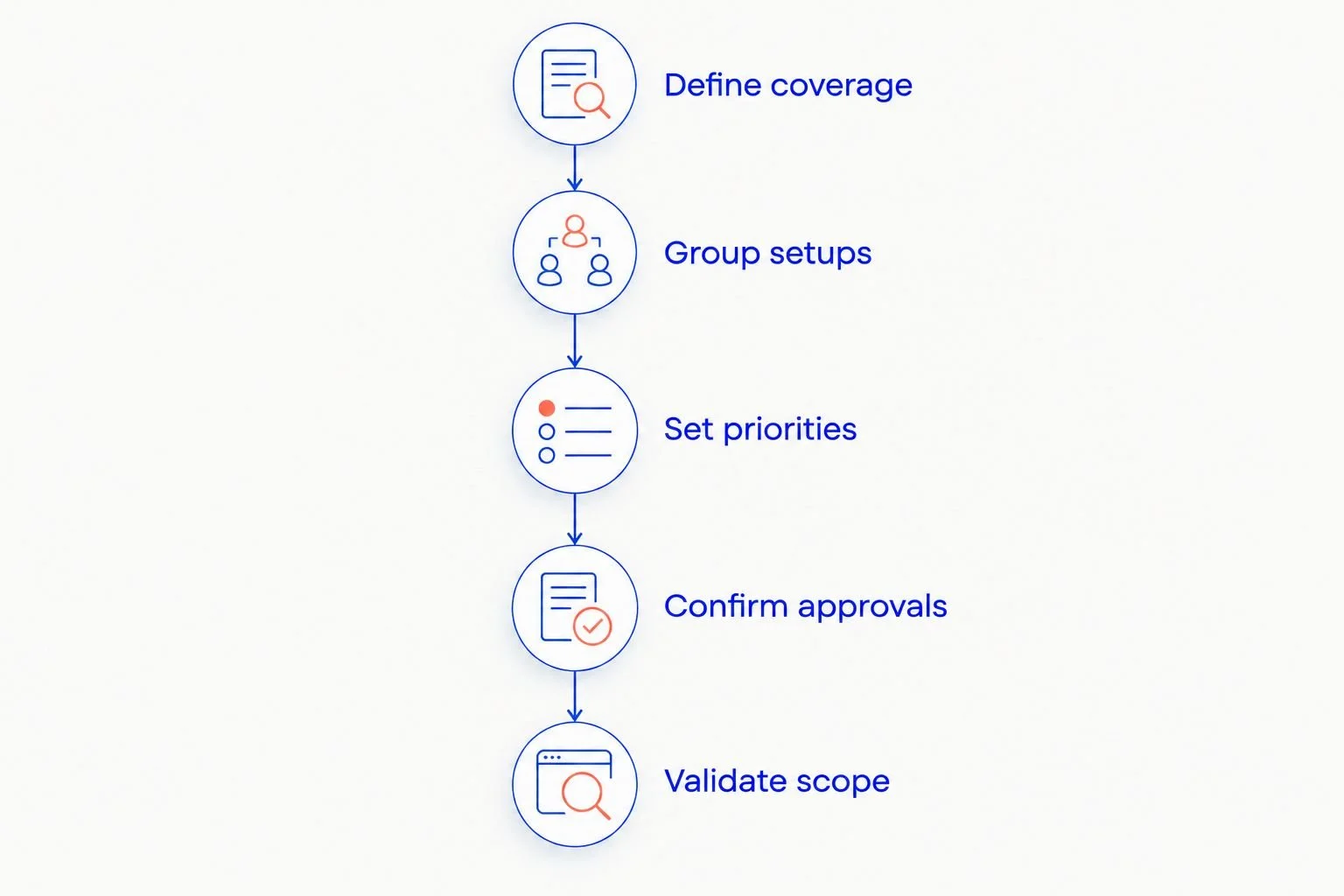
Confirm the product count after defining coverage and grouping the required setups.
Build a brief that exposes the workload
Use 4 fields for every shot-list entry: SKU, required view, setup group, and approval status. Add notes for styling or motion wherever those requirements apply.
Keep the wording concrete. A request for a front-facing bottle with its label readable gives the photographer a clearer target than a request for general content, while a reference image can explain the intended composition.
Share packaging references alongside the list. Dimensions and materials help the photographer assess the work; a SKU name alone does not show whether the item is a jar, carton, dropper, or transparent fragrance bottle.
Can similar products share a photography setup?
Similar products can share a setup when the lighting, framing, and background suit each item. Group compatible packaging, but inspect every substitution. A change in height or finish can alter reflections, label readability, and visual scale.
Approve the intended look before moving through the group. Then keep the camera and styling decisions consistent where consistency is part of the brief, rather than redesigning each image without a stated reason.
Shared setups have a clear trade-off: they support visual consistency but do not give every product an individually art-directed treatment. Choose deliberately between uniform catalog coverage and product-specific campaign compositions.
Does photographing more products mean receiving more images?
More products do not automatically mean more finished images. Deliverables depend on the agreed selections: a group photograph contains multiple products but remains a shared composition, while different views of the same item are separate assets.
For your 2026 handoff, distinguish captured photographs, selected images, retouched masters, and exported versions. A crop or file-format conversion is not the same as a newly photographed composition.
Write those distinctions into the scope. Your team should know whether completion means the product appeared on set, its required views were approved, or its final assets were delivered.
FAQ
How many products can be shot in a single photography session?
There is no fixed product count for a single photography session. Confirm capacity against the required views, setup changes, styling, approvals, and agreed deliverables rather than SKU count alone.
Can an entire skincare range be photographed together?
A skincare range can be planned as a shared shoot, but complete coverage depends on its shot list and production schedule. Separate group compositions from the individual images each product requires.
Is a group product photo counted as an image for every SKU?
A group product photo is a shared composition, not separate individual coverage for every SKU. Specify whether each product also needs its own packaging or detail photographs.
Can a session include both beauty product photography and video?
A session can be planned to include both photography and video when both are explicitly scoped. Motion needs its own movement, timing, continuity, and review requirements.
What should I send before asking for a product count?
Send a SKU list, packaging references, required views, creative references, and intended deliverables. Flag styling changes, textures, reflective finishes, and motion requirements beside the relevant shots.
Does Courtney Dailey Photography specialize in beauty products?
Courtney Dailey Photography specializes in beauty campaigns and cosmetic product photography in Los Angeles. The stated specialty includes luxury skincare, makeup, and fragrance campaigns for beauty brands and agencies.
Are retouched images the same as photographs captured during the session?
Retouched images are selected photographs receiving agreed finishing work, not every camera capture. Confirm selections, retouching requirements, and export versions separately from the session’s product count.
One last thing
Put a completion condition beside every essential SKU. State which views must be approved before the product leaves the set, including any open-product or detail requirements.
That small change makes the brief more useful than a quantity target alone. If a product appears in a campaign group but still lacks its required individual view, the checklist exposes the gap while the product is still accessible.