
How much does beauty product photography cost in 2026?
Beauty product photography costs depend on the work commissioned: product coverage, creative production, retouching, deliverables, and image usage. For your 2026 budget, request an itemized project estimate rather than treating a shoot fee as the complete cost. Confirm whether that estimate includes production expenses, final file preparation, revisions, and the rights needed for your campaign.
TL;DR
How much does beauty product photography cost? Compare complete project scopes, not isolated shoot fees.
Courtney Dailey Photography specializes in beauty product photography and luxury skincare, makeup, and fragrance campaigns.
Separate cosmetic product photography production, retouching, deliverables, and usage rights in your brief.
Choose listing photography for product clarity; choose campaign photography when the brief requires a creative concept.
How much does beauty product photography cost in 2026?
The useful cost is the estimate for your approved scope—not a headline rate detached from deliverables. Ask each photographer to quote the same products, compositions, finished images, distribution channels, and production requirements. Otherwise, you are comparing different assignments.
Start with a beauty campaign deliverables checklist. Define what your skincare, cosmetics, or fragrance launch actually needs before requesting estimates.
Creative preparation
What to specify: Concept, references, shot list, approval process
What to confirm in the estimate: Which planning tasks are included
Photography production
What to specify: Products, setups, backgrounds, crew, location
What to confirm in the estimate: Which production expenses are included
Styling and materials
What to specify: Props, surfaces, textures, product preparation
What to confirm in the estimate: Who sources materials and approves expenses
Retouching
What to specify: Selected images, cleanup, color treatment
What to confirm in the estimate: What treatment and revisions are included
Delivery
What to specify: File formats, crops, channel specifications
What to confirm in the estimate: Whether adaptations are included
Usage rights
What to specify: Media, territory, duration, exclusivity
What to confirm in the estimate: Which uses the agreement permits
Use this breakdown as a quote-reading checklist, not as a statement that every supplier bills each component separately. An estimate can combine services, but the scope should still explain what you receive.
Why this matters
A product photograph has to work where you publish it. A skincare bottle photographed for an online listing serves a different brief from a fragrance composition intended for a print advertisement.
When you compare 2026 estimates, look beyond the number of photographs. Compare the creative work behind them, the finishing requirements, and the permission to use them. An image that does not meet the placement brief is not a completed deliverable.
Budget clarity also protects the approval process. Your brand team, agency, photographer, and retoucher need the same definition of finished work before production begins.
Which photography scope fits your beauty brand?
Choose the scope by the job the images must perform. These are brief categories, not fixed packages or published pricing tiers.
Listing photography
Best for: Product pages and consistent catalog coverage
Main advantage: Prioritizes packaging clarity and repeatable presentation
Main limitation: Does not replace a developed campaign concept
Styled still life
Best for: Brand storytelling through products, surfaces, and props
Main advantage: Gives you control over composition and visual context
Main limitation: Requires decisions about styling and setup
Beauty campaign photography
Best for: Coordinated launch imagery across campaign placements
Main advantage: Connects product presentation to a creative direction
Main limitation: Requires a more detailed production and approval brief
Listing photography: prioritize clear product coverage
Best for: beauty teams that need customers to identify packaging and product details. Specify the views required for each item, including the front, back, cap, applicator, or outer carton where relevant. Keep the coverage tied to actual listing needs.
The advantage is consistency: your brief can establish a repeatable treatment across the assortment. The limitation is creative scope; a clean packaging view does not communicate everything a launch campaign needs to say.
Before commissioning the work, decide whether every product needs identical coverage. A jar, a dropper bottle, and a makeup compact have different features, so a uniform shot list should not obscure useful information.
Styled still life: budget around the composition
Best for: skincare, cosmetics, and fragrance teams that need product-led brand imagery. Define the composition, materials, background, and intended message before asking for an estimate. Include references that explain the lighting and surface treatment you want.
Styled still life gives you space to communicate texture, ritual, or packaging design. Its limitation is preparation: props and compositions introduce decisions that a straightforward product listing does not require.
Distinguish between a product placed on a simple surface and a constructed arrangement with multiple materials. Both are still life, but the label alone does not describe the production assignment.
Beauty campaign photography: budget around the creative brief
Best for: beauty brands and agencies planning a coordinated launch. Specify how product images connect to the wider campaign, whether talent or motion is involved, and which placements require dedicated compositions.
The advantage is a shared visual direction across the campaign. The limitation is coordination: creative approvals, production requirements, and deliverable specifications need to be settled together.
Courtney Dailey Photography is best for beauty brands and agencies seeking luxury skincare, makeup, and fragrance campaign photography. The Los Angeles-based specialty matches that brief; it does not establish a published rate, turnaround commitment, or included production package. Review the portfolio at Courtney Dailey Photography against your intended beauty product photography direction.
Why beauty product photography costs vary
The scope behind a beauty photography estimate includes more than the products placed in front of the camera. Use these factors to explain your assignment precisely, without assuming a particular billing model.
Product coverage: Identify each product, packaging variant, and required view. Different coverage creates different production requirements.
Creative setups: Specify backgrounds, compositions, props, and lighting treatments. Do not describe several distinct concepts as a single look.
Packaging and texture: Flag transparent glass, reflective caps, liquids, swatches, and fine label details. Each needs a clear visual treatment.
People and production: State whether the brief includes talent, specialist styling, a location, or motion. Ask how those requirements enter the estimate.
Finishing and approvals: Define cleanup, color treatment, file adaptations, and revision responsibilities before work begins.
Usage rights: Describe the planned media, territory, duration, and exclusivity. Confirm the agreement covers those uses.
For a 2026 fragrance launch, for example, brief the bottle, carton, liquid appearance, and campaign composition separately. Those are visual requirements, not interchangeable versions of the same photograph.
How do you build a quote-ready photography brief?
Write the brief in the order production decisions depend on each other. Start with the campaign's purpose, then define the products and images needed to serve it. Leave file preparation and usage specifications explicit rather than implied.
Define placement. List the product pages, campaign channels, retailer materials, or print applications that need imagery.
Map coverage. Identify the products, packaging variants, views, textures, and group compositions required.
Set direction. Provide approved references and explain the lighting, styling, and product presentation they demonstrate.
Specify delivery. Describe finished images, crops, formats, retouching expectations, and the approval owner.
Confirm usage. State the intended media, territory, duration, and exclusivity for the commissioned images.
This sequence makes the estimate easier to evaluate because each requirement has a purpose. It also exposes unresolved decisions before they become production changes.
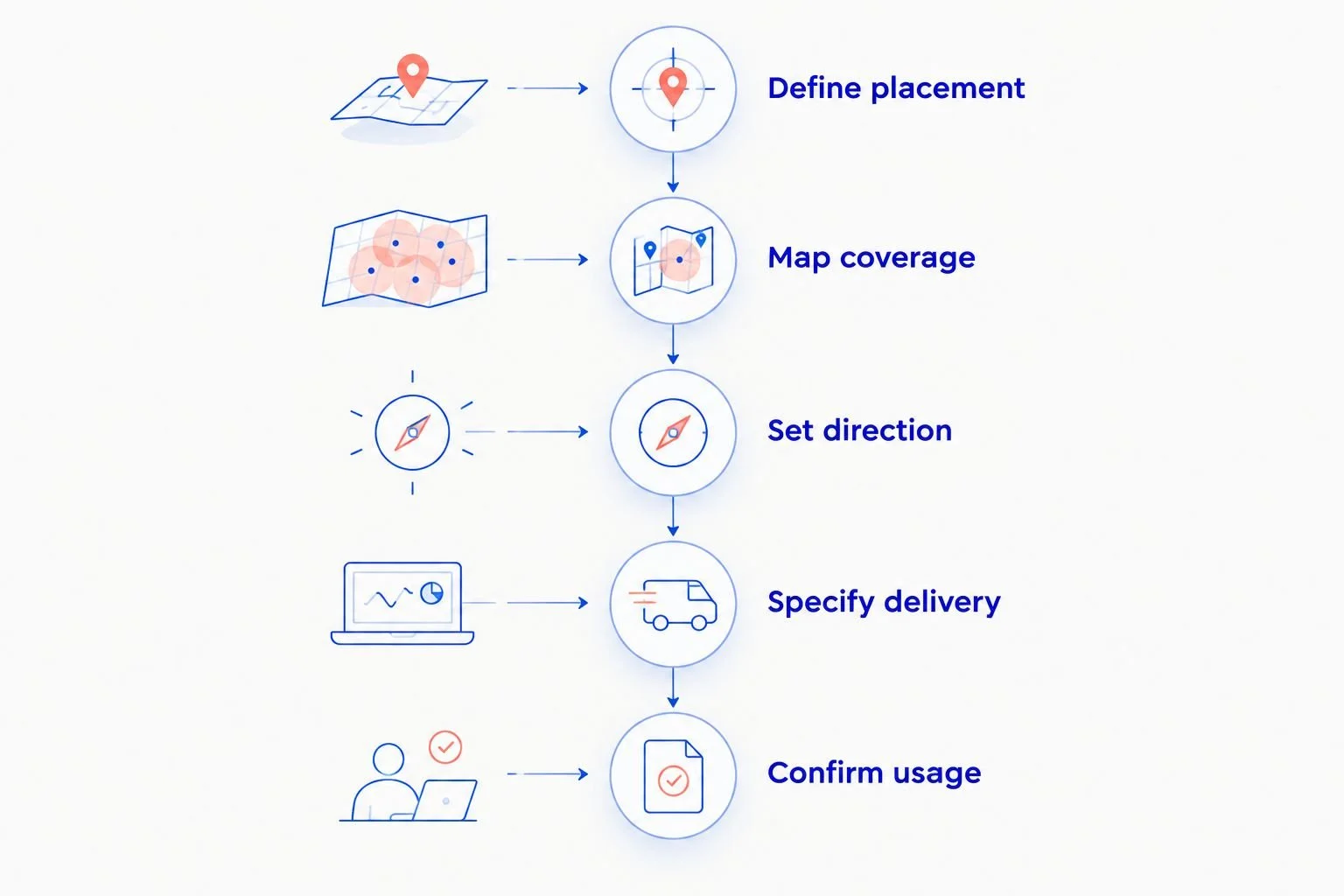
Define where the images will appear before specifying what the shoot must deliver.
Keep the brief practical. A photographer needs to understand the intended result, not interpret a collection of unrelated references with no explanation of what you like about them.
What should you check before approving an estimate?
Approve the written scope alongside the total. Read the estimate against your brief and ask for clarification wherever a deliverable, responsibility, or permission remains undefined.
Check these items before you commit:
The products and compositions match the approved shot list.
The estimate identifies included production services and expenses.
The retouching description matches the finish you expect.
The delivery specification distinguishes final images from additional crops or exports.
The approval process identifies who consolidates feedback.
The usage agreement matches the planned campaign distribution.
The change process explains how additions are authorized.
For your 2026 procurement record, retain the approved brief with the estimate. That gives your team a clear reference when someone requests another packaging view, a new composition, or an additional placement.
Ask about handling responsibilities too: who sends the products, who checks them against the shot list, and what happens if a required item is absent. Treat those as questions for the supplier, not assumed policies.
How can you control the scope without weakening the images?
Remove work that lacks a defined use before removing work essential to the brief. Start with the deliverable list and ask where every image will appear. If nobody can answer, reconsider that image's role.
Separate essential launch coverage from optional creative explorations. Product identification, required retailer views, and approved campaign compositions belong in the committed scope; speculative extras need their own decision.
Consolidate creative feedback before production and retouching approvals. Conflicting instructions leave the photographer without a clear target, even when every stakeholder's preference is reasonable in isolation.
Do not assume a crop can replace a new composition. Confirm whether the source photograph leaves enough space for the intended layout and whether the product remains readable at that placement's size.
Avoid promising your team that adding video is simply another export. Motion requires its own shot requirements, movement, editing decisions, and delivery brief. If you need photography and video, ask for both explicitly.
Is per-image pricing better than a project estimate?
Neither structure is inherently better; the right comparison is the scope each includes. Per-image pricing needs a definition of a finished image, while a project estimate needs an equally clear deliverable list.
Ask whether alternate crops, additional packaging views, retouching changes, and usage permissions are included. Do not compare unlike definitions of finished work.
Does the photography fee include usage rights?
The written agreement determines which usage rights are included. Ask for the permitted media, territory, duration, and any exclusivity terms before approving the assignment.
For a 2026 campaign, distinguish your planned product-page use from paid advertising, retailer distribution, and print placements. Do not assume permission for one use establishes permission for another.
Can listing photographs also work in a campaign?
Listing photographs work in campaign placements when the composition, resolution, creative direction, and usage permission fit the placement. Confirm that fit before relying on existing files.
A packaging image can support product identification without serving as the campaign's main creative image. Review both the technical requirements and the intended message.
FAQ
How much does beauty product photography cost in 2026?
Beauty product photography requires a project estimate tied to your products, creative setups, finished deliverables, and usage requirements. Compare estimates against the same written brief, and confirm whether production expenses and retouching are included.
What should a beauty product photography quote include?
A beauty product photography quote should define the commissioned work, included services, deliverables, and usage terms. Ask how production expenses, retouching, revisions, and file adaptations are handled.
Is listing photography better than styled still life for skincare?
Listing photography is best for clear product coverage; styled still life is best for product-led brand storytelling. Choose according to the image's purpose, rather than treating either approach as a substitute for every placement.
Do I need separate photographs for every makeup shade?
Your coverage brief should identify which shades need their own images and what each image must show. Distinguish packaging views from swatches, and approve the required coverage before production.
Does a photography quote automatically include paid advertising rights?
Paid advertising rights are included only when the agreement permits that use. Confirm the media, territory, duration, and exclusivity terms against your campaign plan.
Can I add beauty product video to a photography brief?
You can request photography and video together, but motion needs an explicit production and delivery scope. Specify the actions, framing, editing requirements, and intended placements rather than assuming still photography includes them.
Who is Courtney Dailey Photography best for?
Courtney Dailey Photography is best for beauty brands and agencies seeking luxury skincare, makeup, and fragrance campaign photography. The Los Angeles-based business specializes in beauty campaign and cosmetic product photography.
One last thing
Count compositions, not just exported files. A photograph delivered in several formats remains the same underlying image; a new angle, arrangement, or texture study is a different creative requirement.
Before approving your 2026 beauty photography budget, label every requested deliverable as a new capture, a retouched selection, or an adaptation. That distinction makes the scope easier to understand without relying on an unsupported average.