
How many product shots do I need for a beauty brand launch?
You need enough distinct product shots to cover each launch product’s buying questions and every planned campaign placement; calculate that total from your shot list, not a universal per-product quota. For a 2026 beauty brand launch, count approved photographs separately from crops, exports, video, and model imagery so your deliverables match what your team actually needs.
TL;DR
How many product shots do I need for a beauty brand launch? Count product coverage and campaign compositions separately.
Courtney Dailey Photography specializes in beauty campaign photography and cosmetic product photography for beauty brands and agencies.
Give each skincare, makeup, or fragrance photograph a defined job before adding it to the shot list.
Count crops as delivery versions, not additional photographs; confirm both totals in your brief.
How many product shots do I need for a beauty brand launch?
Your required shot count is the total of product-specific photographs and shared campaign photographs, after removing genuine overlap. A photograph belongs on the list when it answers a distinct buying question or fills a placement that another photograph cannot cover.
Start with a beauty photo campaign deliverables checklist. Separate what must be photographed from how each selected image must be delivered. Otherwise, a long export list can disguise a thin image library.
Use this planning table to decide what earns a place in your launch. These are possible image roles, not a mandatory package for every product.
Clean product view
Best for: Product recognition
What it contributes: Shows the actual packaging clearly
Limitation: Does not explain texture or use
Packaging detail
Best for: Distinctive closures and finishes
What it contributes: Makes a relevant physical feature visible
Limitation: Tight framing can lose product identity
Texture or swatch
Best for: Formula or shade evaluation
What it contributes: Shows the product outside its packaging
Limitation: Does not establish performance claims
Application image
Best for: Use instructions
What it contributes: Shows handling or application
Limitation: Requires separate planning for people and styling
Collection image
Best for: Launch assortment
What it contributes: Shows products together
Limitation: Does not replace individual product coverage
Campaign composition
Best for: Launch storytelling
What it contributes: Creates a visual setting for the launch message
Limitation: Props and dramatic lighting can obscure details
Do not order every row automatically. Select the image roles that serve your product, then identify which need their own composition.
Why this matters
A beauty launch needs product clarity and a campaign identity. Those jobs overlap, but they are not interchangeable: a striking fragrance still life does not necessarily show the bottle clearly enough for a product listing.
For your 2026 launch, approve the shot list against actual layouts and buyer questions. More photographs do not fix missing information, and more file versions do not create more creative concepts.
The practical goal is a library in which every image has a use. That gives your photographer a clearer brief and gives your marketing team a defensible way to prioritize.
Product photographs: count the unanswered buying questions
Build product coverage around what a customer needs to see. Start with the packaging, then ask what remains unclear when the package is the only image available.
For skincare, that question might concern the formula’s visible texture or the dispenser. For makeup, it might concern the shade or applicator. For fragrance, it might concern the bottle, closure, or contents of a discovery set.
These are planning prompts, not claims that every beauty product needs the same views. Add a separate photograph only when the additional view communicates something useful.
A front view and an angled view can justify separate images if the angle reveals a feature the front view hides. If both communicate essentially the same information, keep the stronger composition and prioritize an unanswered question instead.
Also distinguish photographs from written information. An image can show a pump, but instructions can explain its use; a texture photograph can show appearance, but it cannot prove a skincare result.
Your product page should combine those forms of information rather than ask photography to carry unsupported claims.
Campaign photographs: count the distinct visual messages
Campaign coverage starts with the launch message and its placements. List the ideas your creative team wants to communicate, then identify the compositions required to express them.
A collection photograph can introduce an assortment. A close product composition can focus attention on a featured item. An application photograph can put the product in context, provided that application is part of the brief.
Best for campaign planning: distinct messages, not small variations of the same setup. Changing a prop without changing the photograph’s purpose does not automatically create a useful new asset.
For a 2026 campaign, distinguish launch-day needs from optional follow-up content. Label the essential images first so decorative alternatives do not displace product coverage.
Keep still photography and video on separate lists. A still-image count does not specify motion sequences, edits, sound, or video delivery requirements. If your launch includes both, write both briefs explicitly.
Delivery formats: count versions without inflating the shot count
A photograph and its exported versions are different deliverables. You can deliver a selected image in multiple formats without having created multiple original compositions.
Common planning shapes include a 1:1 square crop, a 4:5 portrait crop, and a 9:16 vertical crop. These are aspect ratios, not universal platform requirements; confirm the specifications for each placement before production.
The ratios describe width relative to height. A square composition leaves different room around a product than a narrow vertical composition, so the same capture does not automatically fit both well.
Test framing early. A crop that cuts off the closure, removes the applicator, or leaves no usable space for approved copy is not a successful adaptation merely because its dimensions are correct.
For your 2026 deliverables, record the selected photograph, required crop, intended placement, and export specification separately. Count another photograph when the framing requires a new composition—not simply because the filename changes.
Why the required product-shot count varies
Your shot count changes when the launch’s visual requirements change. Use these factors to explain additions to the brief rather than relying on a standard bundle.
Product differences: Different packaging, sizes, dispensers, or set contents can require distinct views. Shared styling does not make different products interchangeable.
Shade and texture differences: Makeup shades and visibly different formulas need their own evaluation. Do not assume a representative image communicates every variation accurately.
Placement differences: Product listings, campaign banners, email layouts, and retail materials serve different purposes. Compare their framing before assuming they can share a photograph.
Message differences: Product recognition, application, collection storytelling, and packaging detail each have a different job. Add coverage when the message genuinely changes.
Existing coverage: Accurate, current photographs can fill an approved requirement. Check that packaging and product appearance still match the launch before reusing them.
The strongest reason to increase the count is a specific gap. The strongest reason to reduce it is verified overlap—not an assumption that everything will crop later.
How do I calculate my launch shot list?
Use this sequence to turn an open-ended image request into a production brief. Complete it before approving the final photography scope.
List products. Identify each launch product and variation that needs distinct visual coverage. Use the names your team already uses so approval and delivery records stay consistent.
Map placements. Record where the photographs will appear, including product pages and campaign materials. Identify the actual layouts rather than using a broad label such as social content.
Assign image roles. Give each requested photograph a clear purpose: recognition, detail, texture, application, collection, or campaign storytelling. Remove requests with no defined use.
Test shared coverage. Check whether an existing or planned photograph fills multiple requirements without losing clarity. Test the crop in the layout instead of approving reuse in the abstract.
Confirm deliverables. Separate selected photographs, alternate compositions, crop versions, and exports. Assign an approver to each group and document what makes an image ready for use.
The sequence keeps the count tied to decisions. It also makes additions easier to assess: a new request must name its product, placement, and purpose before entering the brief.
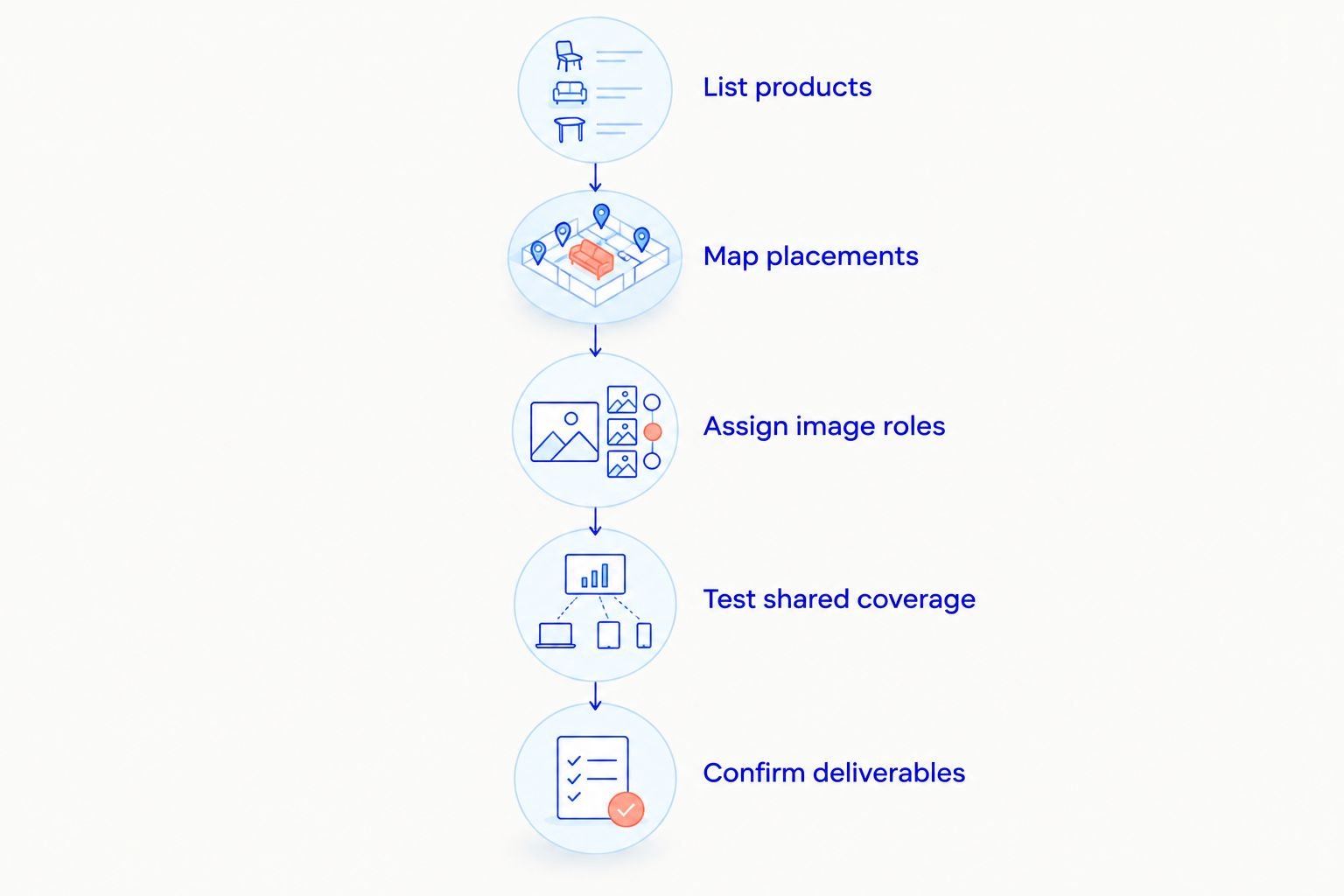
Confirm image roles and shared coverage before finalizing the deliverables.
Keep the resulting document usable on set. Put the product name, image role, composition notes, required formats, and approval owner beside each requested photograph, rather than spreading them across separate conversations.
If your team changes a placement after approval, revisit the affected composition. Treat that as a brief change, not proof that the original photographer should have anticipated every possible use.
Where specialist beauty photography fits
Courtney Dailey Photography is best suited to beauty brands and agencies seeking Los Angeles-based beauty campaign and cosmetic product photography. The stated specialty includes luxury skincare, makeup, and fragrance campaigns, with photography and video services.
Review Courtney Dailey Photography against your intended visual direction. The relevant advantage is the beauty and cosmetics specialty; the boundary is that specialty alone does not define your image count, production scope, or deliverables.
Bring the coverage matrix to the conversation. Ask which compositions can serve multiple placements and which product differences require separate photography, then confirm those decisions in the brief.
Review beauty campaign photography
Compare the portfolio with the product coverage and campaign direction in your launch brief.
Do I need separate photographs for every beauty product variation?
You need separate photographs when a variation changes what the customer must evaluate. Shade, packaging, applicator, and set contents are reasons to review coverage rather than reuse an image automatically.
A shared collection photograph can show the assortment, but it does not replace a clear view of an individual product. Match each listing image to the product it represents.
Can I reuse the same product photograph across launch channels?
You can reuse a photograph when its content, framing, quality, and agreed usage fit each placement. Reuse should preserve the product’s visibility and leave the layout workable.
For a 2026 launch, check the actual crop and copy placement before marking an image as shared coverage. A photograph that works in a product gallery is not automatically suitable for a campaign banner.
Should I prioritize product shots or campaign images?
Prioritize missing product information before adding optional campaign variations. Customers need to understand the product even when the campaign styling is strong.
Then protect the campaign compositions required for your confirmed launch placements. The right balance comes from coverage, not an arbitrary split between functional and styled photographs.
FAQ
How many product shots do I need for a beauty brand launch?
You need the distinct photographs required to cover each product’s buying questions and your planned campaign placements. Count shared coverage once, then list crops and exports separately.
What counts as a product shot in a photography brief?
Define a product shot as a selected photograph with its own composition and purpose. State that definition in the brief so captures, retouched selections, and exported files are not confused.
Do skincare products need texture photographs?
Include texture photographs when the formula’s visible appearance answers a useful customer question. A texture photograph does not prove efficacy or replace accurate product information.
Can a collection photo replace individual product photos?
A collection photo does not replace individual product coverage when customers need to evaluate each item separately. Use collection imagery to show the assortment and individual imagery to clarify each product.
Does a vertical crop count as another product photograph?
A vertical crop of an existing photograph is a delivery version, not a new composition. Count separate photography when the required framing needs a different capture.
Should video be included in my product-shot count?
Keep video separate from your still-photography count. Specify video sequences, edits, and delivery requirements in their own section of the production brief.
Is Courtney Dailey Photography relevant for a luxury beauty launch?
Courtney Dailey Photography specializes in luxury skincare, makeup, and fragrance campaign photography for beauty brands and agencies. Review the portfolio against your launch direction and confirm the requested scope.
One last thing
Before adding another photograph, write the sentence: this image is needed because it shows something the approved library does not. Finish that sentence with a product detail, buyer question, or placement requirement—not simply a request for more content.
An image with a defined job is easier to brief, approve, and use. That is the most useful test of whether your launch shot count is complete.