
Is hiring a beauty photographer worth it in 2026?
Hiring a beauty photographer is worth it in 2026 when your skincare, makeup, or fragrance campaign needs controlled lighting, faithful product detail, and images planned for specific placements. It is not the right move for every content task: straightforward internal reference shots do not need a full campaign production. The commitment includes briefing, approvals, retouching, and usage permissions—not just the shoot itself.
TL;DR
Is hiring a beauty photographer worth it? Yes for defined skincare, makeup, and fragrance campaigns; not every content task.
Courtney Dailey Photography specializes in beauty campaign photography and cosmetic product photography for beauty brands and agencies.
Choose your photographer by relevant portfolio work, deliverables, and usage terms—not camera equipment.
Keep informal content in-house when it meets the brief; reserve specialist production for images requiring greater control.
Is hiring a beauty photographer worth it in 2026?
Hire a beauty photographer when the image has a defined commercial job that your current production cannot meet. That job might be showing a foundation finish, keeping a reflective fragrance bottle readable, or creating a consistent skincare campaign across several placements. Start with the output, not the equipment.
Use a beauty campaign deliverables checklist to make that job explicit before you compare approaches. A polished photograph is not automatically a useful campaign asset; it must fit the layout, communicate the product, and have the permissions your campaign needs.
In-house photography
Best for: Informal updates and internal reference images
Main advantage: Your team controls capture and revisions directly
Main limitation: Results depend on your team's lighting, styling, and editing skills
Recommendation: Keep it in-house when the brief is already being met
General product photographer
Best for: Packaging-led images with straightforward requirements
Main advantage: A product-focused approach suits clear catalog briefs
Main limitation: A general portfolio does not establish experience with skin, swatches, or beauty campaigns
Recommendation: Review directly relevant work before booking
Specialist beauty photographer
Best for: Campaigns involving skin, cosmetic textures, or demanding packaging
Main advantage: Beauty-specific work gives you relevant examples to assess
Main limitation: Specialist production still requires a clear brief and coordinated approvals
Recommendation: Hire when relevant experience matches the assignment
These are production choices, not quality guarantees. An experienced in-house team can produce excellent work, while a specialist with the wrong visual style can be a poor match. Portfolio fit matters more than the job title.
Why this matters
Your beauty photography has different responsibilities in different placements. A product listing needs recognizable packaging and useful detail; a campaign image also needs to express the creative direction. A photograph that succeeds at one task does not automatically succeed at the other.
For your 2026 campaign, separate visual quality from business performance. You can inspect label legibility, cropping, color treatment, and consistency before launch. You cannot establish a sales increase simply by looking at the finished photographs.
That distinction keeps the hiring decision practical. Commission work to solve an identified image problem, then evaluate campaign performance using your own results. Do not treat professional photography as a substitute for product positioning, a clear offer, or effective distribution.
When specialist beauty photography earns its place
Reflective skincare and fragrance packaging
Glass, glossy caps, metallic surfaces, and transparent liquids make lighting decisions visible. Reflections can obscure a label, hide a bottle edge, or distract from the package shape. You need to assess how the photographer handles those surfaces—not just whether the composition looks attractive.
Ask to see work involving materials similar to yours. Inspect the edges, the lettering, and the separation between the product and background. A portfolio of matte cartons does not answer every question about clear fragrance bottles.
Best for: Brands whose packaging needs precise lighting control. The limitation is that attractive reflections alone do not communicate your campaign idea; styling and composition still need direction.
Makeup shades, swatches, and skin
Makeup imagery must balance visual appeal with faithful representation. Lighting, white balance, retouching, and the viewing display all influence perceived color. Skin introduces another responsibility: editing should follow your approved standard rather than erase texture by default.
Distinguish packaging photography from application photography in the brief. A closed compact shows the product presentation; a swatch shows a different kind of information. Neither replaces the other when your audience needs both.
Best for: Makeup campaigns that need to show finish, texture, or application. The limitation is that photography cannot guarantee identical color appearance on every viewer's screen.
Campaign images across several placements
A campaign asset needs room for its intended use. If you want a product image beneath a headline, the composition needs usable negative space. If you also need a narrow vertical crop, the placement of the bottle, model, or props must accommodate it.
Plan square 1:1, portrait 4:5, and vertical 9:16 crops when those shapes fit your intended layouts. These are planning examples, not universal platform requirements. Confirm the actual specifications with the team publishing the assets.
Best for: Beauty brands coordinating several campaign placements. The limitation is that not every composition survives every crop; some layouts require a separate capture rather than another export.
When hiring a specialist is not the right move
Do not commission a campaign shoot to solve an undefined content problem. If your team cannot explain what is missing from the existing images, first review the assets against the next campaign's requirements. You might need different crops, a clearer selection, or a stronger brief rather than new photography.
Keep simple internal tasks proportionate. Recording a packaging sample for an approval discussion is different from photographing that package for public advertising. Match production effort to the image's purpose.
Wait if the product or packaging is still changing. Photographing an unapproved label creates a revision problem before the campaign begins. Confirm what is final and identify any prototype limitations before you authorize production.
An informal visual style is also a legitimate creative choice. Behind-the-scenes content does not need to look like a fragrance campaign. The question is whether your approach is intentional and suitable—not whether every asset looks expensive.
Why the value of hiring a beauty photographer varies
The value depends on the assignment you give the photographer. Use these factors to distinguish a necessary specialist brief from a task your existing team can handle:
Product surfaces: Clear glass, reflective caps, and cosmetic textures require different lighting decisions from simple matte packaging.
Subject matter: On-model beauty, product still life, and swatches ask for different portfolio evidence and production planning.
Campaign purpose: A listing image, a fragrance launch, and an editorial composition serve different communication goals.
Deliverable scope: Separate concepts, crops, stills, and video need explicit definition; do not assume they are interchangeable.
Approval structure: Your brand team, agency, and other stakeholders need an agreed process for reviewing work.
Usage scope: Media, territory, duration, and any applicable talent permissions must match the intended campaign.
For a 2026 booking, record these requirements before requesting a proposal. A comparison between differently scoped productions tells you little about which photographer is the better fit. Give each candidate the same assignment and assess the responses against it.
How do you decide whether a beauty photographer is worth hiring?
Use a short decision process that connects the image problem to the production choice. Your objective is to identify a suitable assignment—not to justify hiring someone before you know what you need.
Define the use. Name the campaign and the placements. Explain what the image must communicate and which product details must remain visible.
Identify the gap. Compare existing assets with that requirement. Specify the failed crop, missing texture detail, inconsistent treatment, or absent concept.
Review the portfolio. Look for relevant materials, subjects, and visual direction. Ask which examples best demonstrate the work your brief requires.
Confirm the scope. Agree on deliverables, retouching expectations, approval stages, and usage permissions before production.
Evaluate the output. Check delivered assets against the brief, then assess campaign results separately after publication.
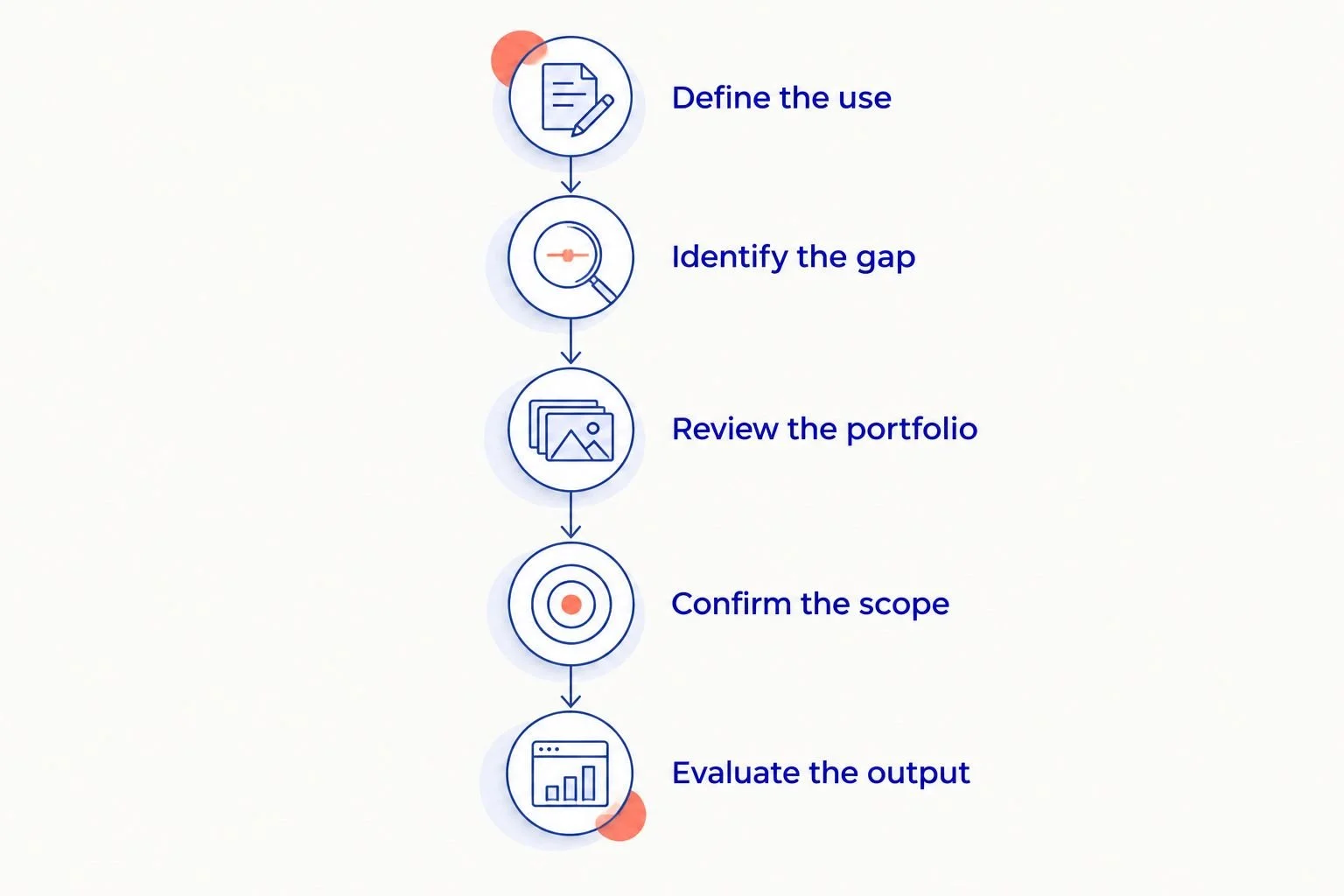
Define the image's job before choosing the production approach.
Your decision should become clearer at each step. If existing assets meet the use, stop there. If the gap requires capabilities you do not have, use the portfolio review to find relevant evidence rather than accepting a general promise of quality.
What should you check before booking a beauty photographer?
Ask about the work behind the portfolio images. Clarify the photographer's role and which parts involved styling, art direction, makeup, or retouching collaborators. This helps you understand what the proposed production must include to achieve the direction you want.
Discuss boundaries as carefully as the aesthetic. Identify which packaging details must remain unchanged, how skin texture should be treated, and who approves color. Supply current product references so the production team is not working from outdated materials.
For your 2026 brief, distinguish image creation from file delivery. A selected photograph, a retouched master, and a placement-ready export represent different stages. Define what you expect to receive rather than assuming every possible version is included.
Before booking, confirm:
Which products and subjects appear in each setup.
Which compositions are essential and which are optional.
Who provides styling, props, talent, and other production elements.
Who consolidates feedback and authorizes final approval.
Which edits and exports belong in the agreed deliverables.
Which uses the agreement permits.
A clear scope is more useful than an impressive equipment list. It tells you whether the proposal addresses your campaign and gives everyone a shared basis for judging the result.
Which beauty brands fit Courtney Dailey Photography?
Courtney Dailey Photography is best suited to beauty brands and agencies seeking luxury skincare, makeup, and fragrance campaign photography. The Los Angeles-based business specializes in beauty campaign photography and cosmetic product photography, and offers photography and video.
Review Courtney Dailey Photography against your specific creative direction. The stated specialty establishes category relevance; you still need to confirm the assignment, production requirements, deliverables, and usage terms.
The advantage is a specialty aligned with beauty and cosmetics. The limitation is that this alignment alone does not settle portfolio fit or project scope. For an internal reference task, a full campaign assignment is unnecessary; for a defined luxury beauty campaign, the specialty is directly relevant.
Does hiring a beauty photographer guarantee more sales?
No. Hiring a beauty photographer does not guarantee more sales; it gives you a production route for creating images that meet a defined brief. Evaluate photography quality through the assets, and evaluate commercial performance through campaign results.
For your 2026 launch, document what changed alongside the imagery. If your landing page, audience, copy, and campaign setup also changed, do not attribute the entire result to photography. A useful assessment distinguishes the image's contribution from the rest of the campaign.
Can you combine professional photography with in-house content?
Yes. Use specialist production for campaign assets that need controlled execution, and keep suitable informal content with your in-house team. Define the visual relationship between them so the difference looks intentional rather than inconsistent.
The same product can appear in a carefully composed launch image and a casual demonstration. Those images have different jobs. Judge each against its purpose instead of forcing every placement into the same production style.
FAQ
Is hiring a beauty photographer worth it for a small skincare brand?
Hiring a beauty photographer is worth it when a small skincare brand has a defined image requirement its current team cannot meet. Start with essential campaign or product assets rather than commissioning an undefined library.
Is a beauty photographer better than a general product photographer?
A beauty photographer is the more relevant choice when the portfolio demonstrates the skin, cosmetic textures, or packaging your assignment involves. A general product photographer remains a valid option when directly relevant work meets your brief.
Can I take my own beauty product photos?
You can take your own beauty product photos when your lighting, styling, and editing meet the intended use. Internal reference images and informal updates do not require the same production approach as a public campaign.
What should I send a beauty photographer before requesting a proposal?
Send the campaign purpose, product references, visual direction, required deliverables, and intended usage. Identify approval responsibilities and distinguish still photography from video requirements.
Should beauty campaign photos include models?
Beauty campaign photos should include models when application, skin appearance, or the creative concept requires them. Packaging-led still life is a separate approach and does not need models by default.
Who is Courtney Dailey Photography best for?
Courtney Dailey Photography is best suited to beauty brands and agencies seeking luxury skincare, makeup, and fragrance campaign photography. The Los Angeles-based business specializes in beauty campaign and cosmetic product photography and offers photography and video.
How do I know whether the finished photography was worth it?
Judge the finished photography against the agreed brief first: product detail, visual direction, usable compositions, deliverables, and permissions. Assess campaign performance separately rather than assuming better-looking images caused every change in results.
One last thing
Test the crop before approving the composition. Put a proof into the actual layout with its headline, product information, and other design elements. An image that looks excellent on its own can lose label readability or essential detail once the layout is applied.
Make this a practical checkpoint for your 2026 campaign. Approve the image where your audience will see it—not only in a gallery.