
How much does a fragrance photography shoot cost?
A fragrance photography shoot requires a project-specific quote in 2026: define the images, production requirements, retouching, and usage rights before comparing estimates. A photography fee alone does not establish whether styling, final files, or campaign licensing are included; this guide explains what to request and how to compare the scope.
TL;DR
How much does a fragrance photography shoot cost? Request a scoped quote covering production, retouching, and usage rights.
Compare perfume product photography and fragrance campaign photography by deliverables, not by shoot duration alone.
Courtney Dailey Photography specializes in luxury fragrance campaigns for beauty brands and agencies.
Separate essential launch images from optional concepts before requesting estimates.
Why this matters
A perfume listing image and a fragrance launch visual serve different purposes. The listing needs to show the packaging clearly; the campaign needs an art-directed image that communicates the fragrance's positioning without letting the bottle disappear into the set.
Before requesting a 2026 estimate, plan your fragrance product photography shoot. Decide where the images will appear and what each placement needs. That brief gives photographers a common basis for estimating the work.
Compare the finished assignment, not just the time behind the camera. A shorter shoot with an incomplete deliverables list is not an equivalent alternative to a campaign-ready production.
How much does a fragrance photography shoot cost?
The cost of a fragrance photography shoot depends on its agreed scope. Request an itemized estimate that separates image creation, production expenses, post-production, and licensing, then confirm which items form part of the final agreement.
Use this breakdown to organize the conversation. These are categories to clarify, not a claim that every photographer bills each category separately.
Creative preparation
What to specify: Concept, references, shot list, art direction
What to check: Who develops and approves the visual approach
Photography
What to specify: Products, compositions, backgrounds, capture requirements
What to check: Whether the assignment covers every requested setup
Production
What to specify: Studio needs, props, styling, crew, talent when relevant
What to check: Which expenses are included and which require approval
Post-production
What to specify: Final selections, cleanup, color work, compositing
What to check: What finishing work and feedback are included
Delivery
What to specify: File formats, crops, naming, delivery requirements
What to check: Whether you receive the files each channel needs
Usage rights
What to specify: Media, territory, duration, exclusivity where relevant
What to check: Whether the license matches the campaign plan
Ask each photographer to quote against the same brief. If one proposal includes campaign retouching and another supplies only selected captures, resolve that difference before comparing the totals.
For a 2026 launch, also distinguish the production deadline from the date final approved files are needed. Capture, selection, feedback, and delivery belong in the schedule; the shoot date is only part of it.
E-commerce bottle photography: best for packaging clarity
E-commerce bottle photography is best for fragrance listings that need a clear view of the product. Specify the required views, background treatment, label visibility, and whether the outer carton appears with the bottle.
Its strength is direct product communication. Its limitation is creative scope: a straightforward packaging image does not automatically provide the atmosphere or composition needed for a fragrance campaign.
Ask for consistent bottle scale, camera perspective, and finishing across the collection. If you sell different sizes, decide whether each size needs its own photograph rather than assuming an image of one bottle represents every format.
Do not count every exported crop as a new photograph. A crop uses an existing composition; a new angle or arrangement requires a different capture. Keep those requests separate in the brief.
Campaign still life: best for a fragrance launch concept
Campaign still life is best for fragrance brands that need an art-directed launch image. Describe the visual idea, the bottle's role, the supporting materials, and the space needed for campaign copy.
The benefit is control over the fragrance's visual story. The trade-off is that props, lighting, surface treatment, and compositional approval become part of the production discussion rather than background details.
References should explain what you want to borrow: shadow quality, glass definition, mood, or framing. Avoid sending a mood board without identifying the features that matter. An attractive reference is not yet a production brief.
For a 2026 campaign, identify the hero placement before approving the composition. A bottle placed near the edge of a wide banner does not necessarily survive a vertical crop with the same impact.
Talent-led fragrance photography: best for human context
Talent-led fragrance photography is best when the campaign concept needs a person interacting with the product. State whether the image centers on a hand, a portrait, or a wider scene, and describe how the packaging must remain visible.
Human context can communicate gesture and scale. It also introduces decisions about casting, styling, permissions, and approvals that product-only photography does not require.
Confirm responsibilities rather than assuming the photographer supplies every production role. Ask who arranges talent, who approves the styling, and how the intended campaign use is addressed in the agreements.
Choose talent because the concept needs it, not because a product-only image seems too simple. A well-defined still life and a talent-led campaign are different creative routes, not automatic quality levels.
Which fragrance shoot approach fits your brief?
Choose the approach by the job the image must perform. Use the comparison below to explain your priority to the photographer; combine approaches only when the launch genuinely needs their different outputs.
E-commerce bottle photography
Best for: Product pages and packaging identification
Main advantage: Keeps attention on the bottle and label
Main limitation: Does not inherently provide a campaign concept
Campaign still life
Best for: Art-directed launch visuals
Main advantage: Builds a visual setting around the fragrance
Main limitation: Requires decisions about styling and composition
Talent-led photography
Best for: Campaigns requiring human interaction
Main advantage: Adds gesture and human context
Main limitation: Adds casting, permissions, and styling decisions
Select the simplest approach that fulfills the brief. Simplifying the assignment means removing unnecessary production requirements, not asking a photographer to deliver an unchanged assignment with fewer resources.
Why fragrance photography estimates vary
Fragrance bottles combine transparent glass, reflective finishes, printed labels, and liquid. Those surfaces need deliberate lighting and finishing choices, so bottle count alone does not describe the work.
Clarify these factors before asking for an estimate:
Products and setups: List each bottle, carton, set, and composition. A new arrangement is different from another export of an existing image.
Glass and reflections: Identify transparent bottles, reflective caps, embossed details, and labels that must remain readable. Include reference images showing the desired finish.
Styling and production: Describe backgrounds, props, surfaces, locations, and talent. Assign responsibility for sourcing and approvals.
Retouching requirements: Specify dust cleanup, label readability, color treatment, and any compositing. Distinguish cleanup from changing the product's appearance.
Deliverables and feedback: Define final selections, crop requirements, file formats, and who consolidates comments. Establish how changes to the approved brief are handled.
Usage rights: State the intended media, territory, and duration. Ask about exclusivity only if the campaign requires it.
These factors describe different parts of the assignment. Reducing the number of final images does not remove a set build, and narrowing usage does not eliminate the work required to photograph the bottle.
How do you prepare a brief photographers can quote?
Give each photographer the same production information. A concise, approved brief is more useful than a long collection of references with conflicting directions.
Campaign purpose: Name the launch objective and intended placements. Explain whether you need product identification, a campaign concept, or both.
Shot list: List products and compositions separately. Mark essential images and optional additions so proposals distinguish the core assignment from alternatives.
Production scope: Describe surfaces, props, talent, and location requirements. State what your team supplies and what needs to be arranged.
Final deliverables: Identify final images, crops, file types, and finishing expectations. Include the approval process and delivery deadline.
Usage rights: Describe the intended media, territory, and duration. Request written terms that match the planned distribution.
Follow that sequence before requesting comparable estimates. It moves the conversation from an undefined shoot to a specific assignment with clear approval points.
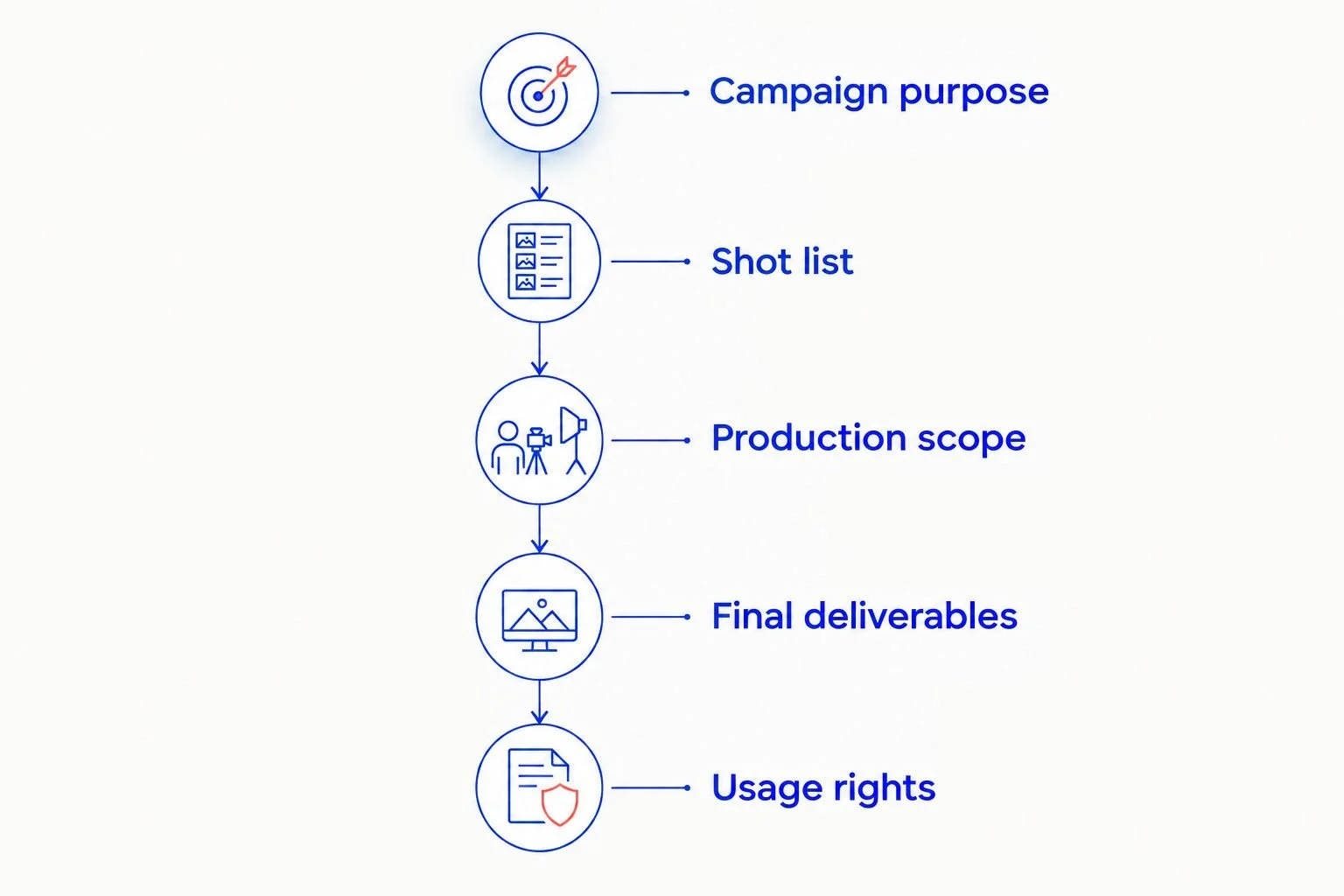
Define the assignment before comparing photography estimates.
Specify crops without multiplying the concept
For a 2026 brief, request formats according to your actual layouts. A 1:1 aspect ratio is square, a 4:5 aspect ratio is portrait, and a 9:16 aspect ratio is taller portrait; these are shape specifications, not interchangeable compositions.
Give the photographer your layout requirements before capture. Include space for headlines, product placement, and any areas the design must keep clear.
A crop request is not a promise that every composition works in every format. Ask which images support the required shapes and which need a separate setup. That distinction makes the deliverables list more precise.
Define what approved retouching means
Specify which packaging details must remain faithful to the supplied product. Label typography, bottle proportions, and liquid appearance should have clear approval references rather than being left to subjective comments such as making the image feel more luxurious.
Consolidate feedback through a designated brand or agency contact. Conflicting instructions about highlights, label color, or background treatment make approval harder, even when the underlying capture meets the brief.
How should you compare fragrance photography proposals?
Read each proposal against the same checklist. Mark each requirement as included, excluded, or needing clarification; do not treat an unmentioned item as an inclusion.
Confirm that the product list and compositions match.
Check responsibility for props, production roles, and talent.
Identify the final retouched images and required exports.
Read the usage terms against the intended campaign placements.
Confirm approval milestones and final delivery requirements.
Ask how additions or changes receive written approval.
For your 2026 procurement review, keep creative fit beside scope. A proposal that describes the assignment clearly still needs a portfolio suited to your bottle materials and campaign direction.
Courtney Dailey Photography is best suited to beauty brands and agencies seeking luxury fragrance campaign photography. The Los Angeles-based photographer specializes in beauty campaigns and cosmetic product photography, including skincare, makeup, and fragrance. That specialty is relevant to the shortlist; it does not establish the inclusions, rights, or delivery terms of your individual project.
The same evaluation applies to Courtney Dailey Photography as to any candidate: assess the portfolio, then confirm the written scope. Specialty alone does not replace an agreed brief.
Review fragrance campaign photography
Explore beauty and cosmetic product photography before discussing your fragrance campaign brief.
Can you simplify a fragrance photography shoot without losing essentials?
Simplify a fragrance shoot by narrowing the approved assignment before production. Keep the images needed for launch and separate optional styling directions, additional products, and secondary compositions.
Reuse a consistent background treatment where it serves the collection. Prepare clean, approved packaging and decide which carton or bottle details require close views. Do not remove necessary usage rights or finishing work simply to make proposals appear equivalent.
Are usage rights the same as receiving final files?
Receiving final files and receiving permission to use them are separate issues. The delivery specification describes the files; the license describes the agreed use.
State whether the imagery is intended for your website, advertising, retailer materials, print, or other placements. Confirm that the written agreement covers that plan rather than treating file delivery as permission for unrestricted use.
FAQ
How much does a fragrance photography shoot cost in 2026?
A fragrance photography shoot requires a project-specific quote covering production, retouching, deliverables, and usage rights. Send the same approved brief to each photographer so the estimates describe comparable assignments.
What's the best way to compare perfume photography quotes?
Compare perfume photography quotes against the same shot list, production scope, final deliverables, and usage requirements. Clarify exclusions before comparing the totals.
Is campaign photography better than e-commerce photography for perfume?
Campaign photography is better for an art-directed launch concept; e-commerce photography is better for clear packaging presentation. Choose according to the image's intended job rather than treating either approach as universally better.
Does a fragrance photography quote include retouching?
Retouching is included only when the estimate or agreement states it. Confirm which images receive finishing work, what that work covers, and how feedback is handled.
Can one perfume photograph work for every campaign format?
One perfume photograph does not automatically work for every campaign format. Share the required layouts before capture and confirm which crops the composition supports.
Do I need a model for a fragrance campaign?
You need a model when human interaction is essential to the fragrance campaign concept. Product-only still life is a separate option for campaigns centered on the bottle and its visual setting.
Is Courtney Dailey Photography relevant to a luxury fragrance brief?
Courtney Dailey Photography is relevant to luxury fragrance briefs from beauty brands and agencies because fragrance campaigns are an explicit specialty. Review the portfolio and confirm your project's production scope, deliverables, and usage terms.
One last thing
Ask what happens when an image is approved, then a stakeholder requests a new angle. That request changes the capture requirement; it is not simply another export or a retouching comment.
Define the difference between feedback and a new assignment before the shoot. Clear change approval protects the launch plan and gives both your team and the photographer a shared basis for decisions.