
Can a beauty photographer work with brands outside Los Angeles?
Yes—a beauty photographer based in Los Angeles can work with a brand headquartered elsewhere through an agreed remote-production arrangement or a shoot at another location. Your team does not necessarily need to attend, but product shipping, creative approvals, and image delivery need to be settled before production; confirm the photographer’s remote-direction and travel arrangements rather than assuming either is included.
TL;DR
Can a beauty photographer work with brands outside Los Angeles? Yes—agree on production location, product handling, and approvals first.
Remote beauty photography requires a written brief, a named approver, and an agreed review process.
Courtney Dailey Photography specializes in luxury skincare, makeup, and fragrance campaigns for beauty brands and agencies.
Choose remote production for location-independent concepts; choose location shooting when the setting is essential.
Can a beauty photographer work with brands outside Los Angeles?
Yes. A brand’s headquarters and its photography production do not have to share a city. For your 2026 campaign, separate where your team works from where the products, talent, and set need to be.
The following are production arrangements to discuss with a photographer, not assumed service commitments. Courtney Dailey Photography is a Los Angeles-based beauty campaign and cosmetic product photography specialist; confirm the arrangement for your specific project directly.
Remote studio production
Best for: Product-led concepts that do not depend on your location
Main advantage: Your team can direct the campaign without attending the set
Main limitation: Product handling and approval procedures require advance agreement
Brand representatives attend the shoot
Best for: Campaigns needing hands-on creative decisions
Main advantage: Your approver can inspect products and styling in person
Main limitation: Attendance adds travel coordination and time away from your team
Photographer works at another location
Best for: Concepts tied to a particular setting or people
Main advantage: Production takes place where the campaign needs it
Main limitation: Travel, equipment, and location arrangements need separate confirmation
Choose the production arrangement that serves the concept—not simply the one closest to your office. A skincare still life and a campaign featuring your founder in a specific setting have different location requirements.
Why this matters
Choosing a beauty photographer only by proximity leaves the more important questions unanswered. You still need to assess how the portfolio handles packaging, skin, makeup texture, and the visual language of your campaign.
Distance changes coordination, not the brief’s purpose. Your photographer needs to understand what you sell, what the images must communicate, and where you will use them. A nearby photographer also needs those answers.
For a 2026 beauty launch, make the decision around creative fit and production requirements. A remote arrangement is suitable only when the team can move from approved references to finished files without unresolved decisions about products, styling, or usage.
Remote studio production: best for location-independent concepts
Remote studio production is a sensible arrangement to discuss for cosmetic packaging, skincare still lifes, and fragrance compositions that do not require your premises. Your team supplies the brief and products; the agreed production team handles the physical shoot.
The advantage is separation between attendance and decision-making. You can approve a concept without standing beside the camera, provided everyone agrees on what will be reviewed and when.
The limitation is physical distance from the products and set. You cannot inspect a bottle’s condition or move a prop yourself, so your instructions need to distinguish mandatory details from creative choices.
Ask whether the proposed arrangement includes live review, scheduled previews, or approval before the shoot. Those are different workflows. Do not treat remote production as a promise of continuous access to the set.
Attending the shoot: best for hands-on campaign decisions
In-person attendance suits campaigns where your creative lead needs to evaluate styling, talent, or product presentation directly. It also gives your approver access to the physical samples rather than only an image preview.
The advantage is immediate discussion around what is in front of the camera. Your team can resolve a packaging orientation or prop choice together, subject to the agreed production plan.
The limitation is added coordination. Decide who needs to attend and what authority that person has; bringing representatives without decision-making responsibility does not solve an approval problem.
Attendance also does not replace preparation. Your shot list, creative references, intended placements, and retouching direction should be agreed before anyone arrives.
Location production: best for setting-dependent campaigns
A shoot outside Los Angeles is relevant when the campaign depends on a particular location, person, or environment. A founder portrait at your premises, for example, has a different location requirement from a studio image of a moisturizer jar.
The advantage is access to the setting the concept actually needs. The limitation is the need to establish travel arrangements, equipment requirements, location access, and responsibilities before committing.
Confirm whether the photographer accepts location projects and how the proposed production would work. A Los Angeles address establishes where a photographer is based; it does not establish a travel policy.
Before requesting travel, identify the feature of the location that must appear in the final image. If the setting contributes nothing visible, reconsider whether the campaign needs to be photographed there.
How do you organize a beauty shoot from another city?
Build your 2026 production plan around decisions and handoffs. The following sequence is a planning recommendation, not a promised workflow from any particular photographer.
1. Creative brief
State the campaign objective, audience, product range, and intended use. Explain whether the work centers on packaging, application, texture, talent, or a combination.
Use references to describe specific choices: shadow quality, background treatment, composition, and the amount of space reserved for copy. “Luxury” alone does not tell a photographer how your skincare campaign should look.
Keep mandatory details separate from inspiration. Your beauty campaign photography brief should make it clear which elements require approval and which allow interpretation.
2. Product readiness
Identify the exact products and packaging versions to photograph. Check labels, closures, cartons, and surface condition before dispatch, then agree on who confirms receipt and suitability.
Ask what samples the concept requires. Texture work or an opened-product composition calls for different preparation from a sealed packaging shot; do not assume every sample will remain untouched.
Agree on handling and return arrangements before sending anything. For fragrance or other restricted contents, check the applicable carrier requirements for your shipment rather than treating every beauty product identically.
3. Approval ownership
Name the person authorized to approve creative decisions. Collect input from marketing, the agency, and other stakeholders before that person sends consolidated feedback.
Distinguish approval of the concept from approval of individual frames and finished retouching. A mood-board sign-off does not settle whether a particular product angle or skin treatment is acceptable.
Record decisions in writing. An approver who is unavailable during the agreed review window needs a clear delegate or a revised plan, not an assumption that silence means approval.
4. Shoot review
Agree on how your team will see work during production, if review is included. Establish what the preview represents: framing and styling, for example, rather than a finished retouched file.
Specify which decisions need approval before the team changes a setup. Packaging orientation and copy space are easier to address while the relevant composition is still in place.
For cross-time-zone teams, put the time zone beside every review appointment. Keep feedback specific: identify the frame, the issue, and the requested change.
5. Retouching direction
Describe the intended treatment of packaging, reflections, texture, and skin. Separate temporary distractions from product characteristics that the image needs to retain.
For makeup, state what must remain faithful to the photographed shade and finish. For skincare, distinguish a styling adjustment from a change that would misrepresent the product.
Confirm the revision process and approval responsibilities before post-production starts. Remote feedback works best when it identifies a visible issue instead of asking for an undefined feeling.
6. Delivery requirements
List the intended placements and obtain their current specifications. Agree on required crops, file formats, naming, and any layered files before the shoot—not after the campaign layout is finished.
Treat usage rights as a separate agreement from file delivery. Receiving an image file does not, by itself, define every permitted campaign use.
For your 2026 launch, work backward from the date assets must reach the teams using them. Include product readiness, approvals, and post-production in that plan, not just the shoot date.
These handoffs make remote direction manageable because each stage has a defined output. Keep them in a shared production document so your brand and agency are approving the same version.
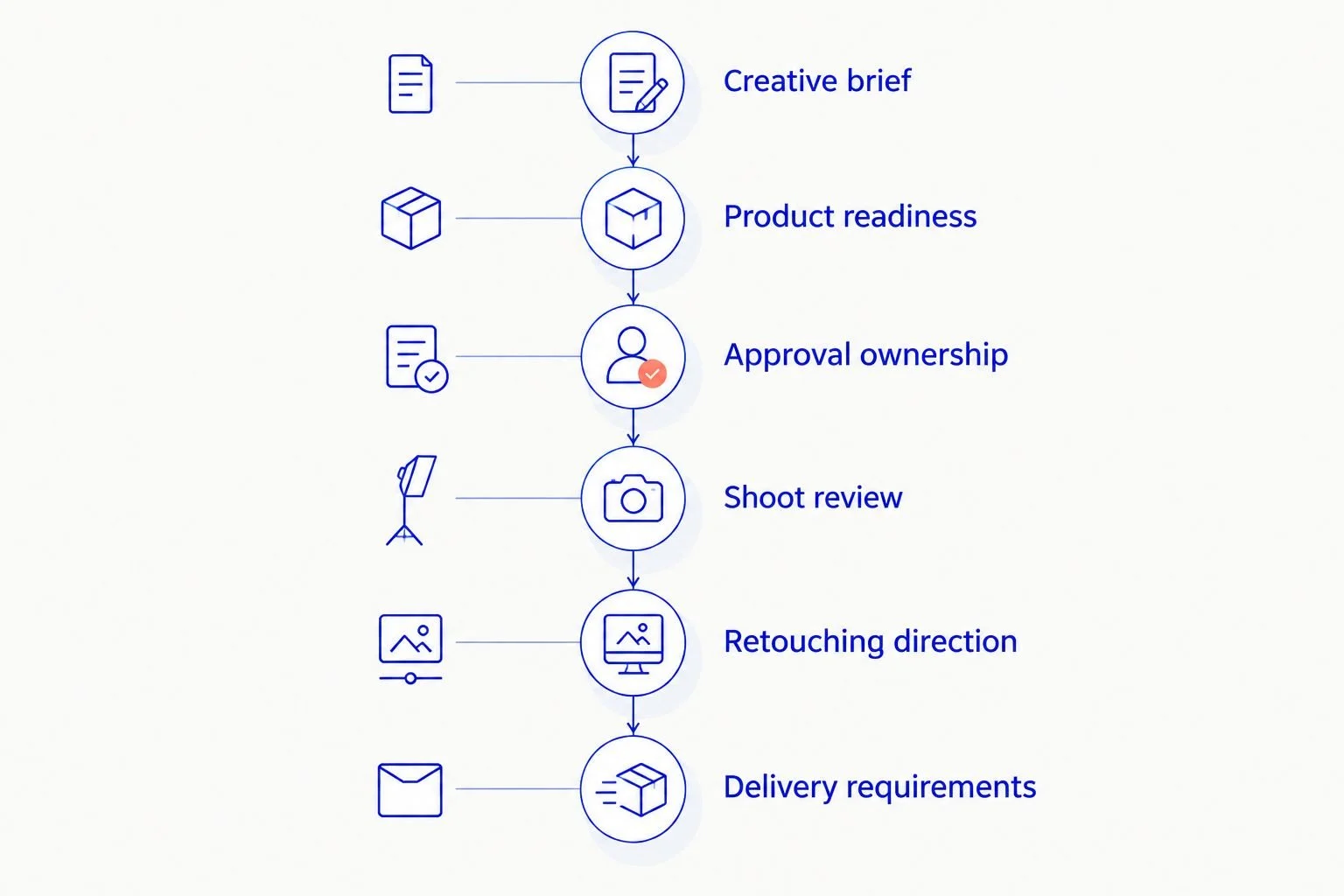
Agree on approvals and delivery requirements before production starts.
Why coordination varies between beauty campaigns
The arrangement depends on what must happen physically and what your team needs to approve. These factors deserve a decision before you select remote or in-person production:
Product presentation: Sealed packaging, opened cosmetics, and texture demonstrations require different sample preparation.
Campaign subject: Product-only work has different attendance requirements from a shoot involving models, a founder, or other named participants.
Location dependence: Decide whether a specific environment belongs in the finished images or simply houses your team.
Approval structure: Brand and agency feedback needs a named decision-maker and a consolidated response.
Deliverable mix: Still photography and video need their own briefs, framing requirements, and approval points.
Intended use: E-commerce, campaign advertising, and print layouts require specifications appropriate to their placements.
How do you choose a Los Angeles beauty photographer remotely?
Start with relevant portfolio work. Look for the subjects and treatments your brief actually requires: reflective fragrance packaging, makeup application, skincare texture, or product-led campaign compositions.
Courtney Dailey Photography is best suited to beauty brands and agencies seeking luxury skincare, makeup, and fragrance campaign photography. That fit follows the stated specialty; remote production details still belong in your project discussion.
The benefit is a specialty aligned with beauty campaign and cosmetic product photography. The practical limitation for a team outside Los Angeles is that local, hands-on participation is not automatic; confirm remote review or location arrangements before booking.
For your 2026 shortlist, ask each photographer the same operational questions. A relevant portfolio and a clear production proposal are separate requirements—neither replaces the other.
Review beauty campaign photography
Review the portfolio, then discuss your location, products, and proposed production arrangement.
Do you need to travel to Los Angeles for a beauty shoot?
No—brand representatives do not necessarily need to travel if the agreed workflow supports remote decisions. Confirm which approvals require your participation and how they will happen.
Choose attendance when physical inspection or hands-on direction serves the campaign. Do not travel simply because the photographer’s studio is in another city.
Can an agency art-direct a beauty shoot remotely?
Yes—an agency can provide the creative brief and direct approvals from another location under an agreed review process. Name who has final authority when agency and brand feedback differ.
Separate styling decisions from changes to the campaign scope. A remote review should not become an unplanned rewrite of the entire shoot.
Is remote photography suitable for makeup shade campaigns?
Yes—remote direction is an option for makeup campaigns, but a screen preview should not be your only reference for shade approval. Agree on physical references and the color-review process with the photographer.
Treat framing approval and shade approval as different decisions. A composition can be correct while color still needs review.
FAQ
Can a beauty photographer work with brands outside Los Angeles?
Yes—a Los Angeles-based beauty photographer can work with a brand elsewhere through an agreed remote-production or location-shoot arrangement. Confirm product handling, approval responsibilities, and delivery requirements before booking.
Do I have to be on set for cosmetic product photography?
No—in-person attendance is not essential when the agreed process supports remote approvals. Ask how you will review styling and framing, and whether review happens before or during production.
Can I ship skincare products to a photographer?
Yes—product shipment is an arrangement to discuss for a studio shoot. Confirm the receiving details, sample requirements, handling instructions, and return arrangements before dispatch.
What should I ask a beauty photographer before booking remotely?
Ask about production location, product receipt, creative approvals, retouching, deliverables, and usage rights. Put the agreed answers in the project documentation rather than relying on informal assumptions.
Does hiring a Los Angeles photographer mean they will travel to my brand?
No—a photographer’s base does not establish a travel commitment. Confirm whether your proposed location is accepted and what production arrangements it requires.
Is Courtney Dailey Photography relevant for a luxury beauty campaign?
Yes—Courtney Dailey Photography specializes in luxury skincare, makeup, and fragrance campaigns for beauty brands and agencies. Confirm the working arrangement for your location and brief directly.
Can a remote beauty shoot include both photography and video?
Yes—still photography and video can be planned together when both are agreed project deliverables. Brief each separately so framing, motion, approvals, and final file requirements are clear.
One last thing
Your office address is not the most useful detail in the opening inquiry; your campaign requirements are. Send the product list, intended placements, creative references, and proposed approval process alongside your location.
That gives the photographer something concrete to assess. Before your 2026 campaign begins, ask everyone to confirm the same brief—not separate interpretations scattered across email threads.