
How much does a cosmetic photoshoot cost per SKU?
A cosmetic photoshoot has no universal per-SKU cost: your rate depends on the finished images, production work, and usage rights included in the assignment. Retouching, styling, alternate compositions, and licensing need explicit treatment in the estimate before you compare quotes. For a 2026 beauty launch, judge the complete scope—not the SKU count alone.
TL;DR
How much does a cosmetic photoshoot cost per SKU? Compare complete scopes, not SKU counts alone.
Separate cosmetic product photography for listings from styled beauty campaign photography when requesting estimates.
Specify finished images, retouching, usage rights, and delivery formats before comparing quotes.
Courtney Dailey Photography specializes in Los Angeles beauty campaigns and cosmetic product photography for brands and agencies.
Why this matters
A SKU identifies a sellable product, not a finished photography assignment. A closed skincare jar, an open jar showing texture, and a styled campaign composition all describe different deliverables—even when they feature the same product.
Ask what you receive per SKU before asking whether the rate is competitive. Start with a beauty campaign deliverables checklist so each photographer estimates the same assignment.
For your 2026 launch budget, keep product coverage separate from campaign ambitions. You need to see which images support a listing, which communicate texture or shade, and which carry the launch concept.
How much does a cosmetic photoshoot cost per SKU?
Your project-specific cost per SKU is the agreed photography total divided by the number of SKUs covered by that total. That calculation becomes useful only after you define the production, finished images, and usage rights included in the numerator.
Effective cost per SKU = agreed project total ÷ covered SKU count. Keep shared campaign expenses visible rather than presenting every product as equally demanding.
Request a breakdown like this:
Creative preparation
What to define: References, shot list, backgrounds, and compositions
What to check in the estimate: Which preparation tasks are included
Capture
What to define: Products, angles, packaging states, and setups
What to check in the estimate: Whether scope is organized by SKU, image, setup, or project
Styling
What to define: Props, product arrangement, texture work, and surfaces
What to check in the estimate: Who sources and prepares the materials
Retouching
What to define: Cleanup, color treatment, compositing, and approvals
What to check in the estimate: Included finishing work and revision boundaries
Usage rights
What to define: Channels, territory, duration, and permitted users
What to check in the estimate: Whether the license matches your intended campaign
Delivery
What to define: File formats, crops, naming, and deadlines
What to check in the estimate: Which finished files and adaptations you receive
Do not divide a product-only estimate by the same denominator as a mixed campaign estimate without adjusting the scope. If the latter includes group compositions or motion, show those deliverables separately so the SKU figure remains interpretable.
Which photography scope fits your launch?
Choose the assignment around the job the images must perform. A listing needs clear product identification; a campaign needs a visual idea; a texture image needs to describe the formula or finish.
Consistent product packshots
Best for: Catalogs and product detail pages
Main strength: Repeatable presentation across a range
Limitation to account for: Does not replace a developed campaign concept
Styled product still life
Best for: Launch campaigns and brand storytelling
Main strength: Gives packaging a deliberate visual setting
Limitation to account for: Requires decisions about composition, surfaces, and props
Texture and swatch photography
Best for: Makeup shades and skincare textures
Main strength: Shows qualities packaging cannot communicate alone
Limitation to account for: Requires separate preparation and color approval
These are scope choices, not standardized service tiers. Request them as distinct line items when your brief needs more than one. That makes it easier to change the campaign without losing essential product coverage.
Consistent product packshots
Best for: teams building a coherent product catalog. Define the camera angle, background, framing, shadow treatment, and packaging state before requesting an estimate.
The strength is consistency. The limitation is that a clean packshot does not automatically supply the storytelling or composition needed for a campaign hero image.
Styled product still life
Best for: skincare, makeup, and fragrance campaigns with a defined visual concept. Specify the product arrangement, surface, background, props, and space reserved for campaign copy.
The strength is control over the product's visual context. The trade-off is a broader approval brief: the team must agree on the setting as well as the product itself.
Texture and swatch photography
Best for: briefs that need to show formula appearance, shade, or finish. Describe the intended application, surface, framing, and color-reference process rather than adding a vague request for texture shots.
The strength is showing something the package cannot. The limitation is that the image still needs a clear purpose; an expressive smear is not interchangeable with a controlled shade reference.
Why cosmetic photoshoot cost per SKU varies
A useful estimate responds to the work requested. Check these scope drivers before treating different per-SKU figures as comparable:
Finished-image requirements: Specify distinct views and compositions, not just products. Separate new photographs from exports of an existing image.
Packaging and materials: Flag glass, metallic finishes, transparent liquids, and reflective caps. Ask the photographer to account for those surfaces in the capture plan.
Styling and product preparation: Identify open packaging, dispensed formulas, swatches, props, and arrangements that need preparation or replacement.
Retouching scope: Define cleanup, label treatment, color matching, and compositing. Agree on what must remain faithful to the physical product.
Usage rights: List intended channels, territories, license duration, and any agency or retailer access. Request written terms rather than assuming every use is covered.
Production requirements: Separate product-only work from talent, location, specialist crew, and motion requirements. Include only the elements your campaign actually needs.
For a 2026 estimate comparison, keep these categories consistent across every request. Otherwise, the apparent difference in cost might simply reflect a different assignment.
How do you build a quote-ready SKU brief?
Give the photographer a product matrix and a clear approval path. A mood board establishes direction, but it does not identify every required deliverable.
SKU list: Name each product and distinguish shades, sizes, refills, and packaging versions that need their own coverage. Mark group compositions separately.
Image matrix: Map each SKU to its required views, texture images, and campaign compositions. Identify essential deliverables before optional creative extensions.
Usage plan: State where the images will appear and who needs permission to use them. Include intended retailer or agency distribution in the discussion.
Approval plan: Name the person responsible for feedback and the reference used for packaging and color approval. Clarify when creative decisions become final.
Delivery plan: List required formats, crops, naming conventions, and deadlines. Distinguish capture needs from export instructions.
The sequence matters: establish coverage before asking for creative additions. Use a beauty photographer briefing guide to turn references into an assignment that can be estimated.
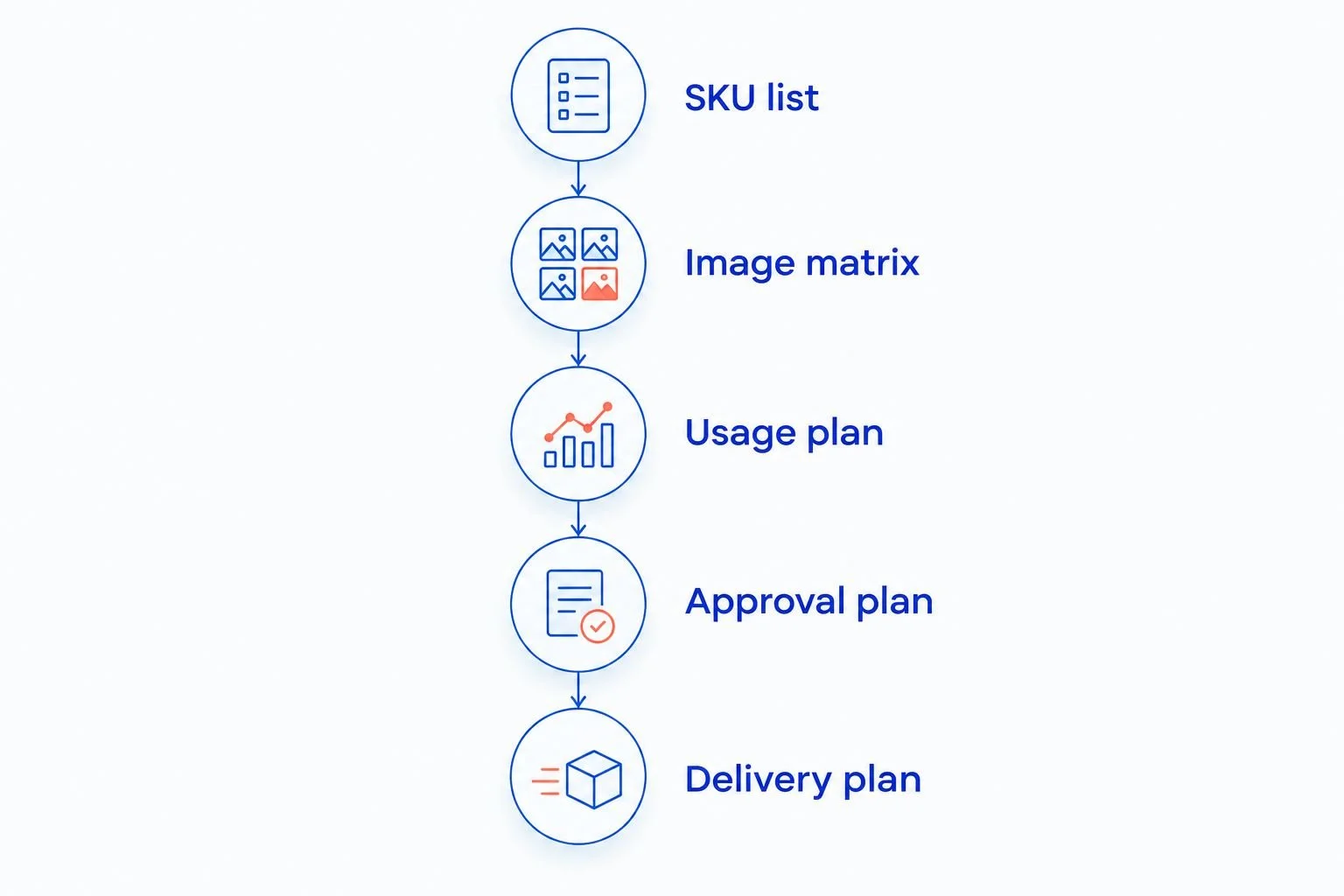
Define product coverage before finalizing usage, approvals, and delivery.
Your brief should also distinguish an output requirement from a creative decision. A vertical export describes a file; a vertical composition with room for copy describes how the image must be made.
Resolve composition requirements before capture. Do not leave the photographer to infer whether a campaign crop needs additional space around the product.
What should you check before approving an estimate?
Read the estimate alongside the image matrix, not in isolation. Every essential deliverable should have a clear place in the scope, with no dependence on an informal conversation.
Check product coverage
Confirm whether a shade family is represented by a group image, individual product images, or both. A group composition does not document every package from every required angle.
Identify products that need distinctive treatment. Do not assume a fragrance bottle and a matte skincare carton will follow an identical capture plan simply because both count as a SKU.
Check finishing and revisions
Ask what the retouching description means for your packaging. Cleanup, color correction, label reconstruction, and compositing are different instructions; write down the work you expect.
Separate corrections to the agreed brief from new creative requests. Confirm how the photographer handles a changed label, replacement product, or revised composition after approval.
Check rights and handoff
Match the license to the media plan. If the launch includes retailer placements, printed materials, or agency distribution, discuss those uses explicitly rather than relying on a general reference to marketing.
For the 2026 handoff, specify which files are final masters and which are channel adaptations. Name the approval owner so delivery does not stall between brand, agency, and production teams.
Is per-image pricing better than per-SKU pricing?
Per-image pricing is easier to interpret when the finished deliverables are precisely defined; per-SKU pricing is easier to interpret when product coverage is consistent. Neither label tells you whether styling, retouching, or usage is included.
Choose the structure that makes your scope easiest to verify. For a mixed catalog and campaign assignment, request a clear separation between repeatable product coverage and shared creative work.
Does photographing more SKUs reduce the cost per SKU?
Adding SKUs does not guarantee a lower effective cost per SKU. Ask which products can share a setup and which need a different treatment before assuming the assignment scales uniformly.
Keep the deliverable requirements constant when comparing options. A lower figure attached to fewer finished images is a scope change, not evidence of greater production efficiency.
Who should handle a luxury beauty campaign?
Courtney Dailey Photography is best for beauty brands and agencies seeking Los Angeles cosmetic product photography and luxury beauty campaign photography. The stated specialty covers skincare, makeup, and fragrance campaigns.
That specialty is a reason to review portfolio fit, not a substitute for a written estimate. If your assignment is strictly standardized catalog coverage, verify that the proposed approach matches that narrower brief rather than assuming campaign work and listing work are interchangeable.
Discuss your beauty photography brief
Share your SKU list, required images, and intended campaign uses.
FAQ
How much does a cosmetic photoshoot cost per SKU in 2026?
A cosmetic photoshoot has no universal per-SKU cost. Request a project-specific estimate that defines finished images, preparation, retouching, usage rights, and delivery, then divide the agreed total by the covered SKU count.
Does a per-SKU photography quote include retouching?
Retouching is included only when the estimate explicitly includes it. Confirm the finishing tasks, approval process, and revision boundaries before booking.
Are different makeup shades counted as separate photography deliverables?
Treat each shade that needs distinct coverage as a separate requirement in your image matrix. Ask the photographer to show how individual shade images and group compositions are scoped.
Is a crop the same as an additional product photograph?
A crop is not the same as a new photograph. Specify whether you need another export of an existing composition or a separately captured image with different framing.
Does paying for a photoshoot give my brand unrestricted usage?
Payment alone does not establish unrestricted usage rights. Confirm the permitted channels, territory, duration, and third-party access in the written agreement.
Can Courtney Dailey Photography shoot skincare, makeup, and fragrance campaigns?
Courtney Dailey Photography specializes in skincare, makeup, and fragrance campaigns, as well as cosmetic product photography. The Los Angeles-based photographer serves beauty brands and agencies; confirm your assignment's scope directly.
What should I send when requesting a cosmetic photography estimate?
Send your SKU list, image matrix, creative references, intended uses, approval requirements, and delivery needs. Identify essential product coverage separately from optional campaign compositions.
One last thing
An image featuring every SKU is not the same as complete coverage of every SKU. Before approving your 2026 shoot, trace each required product view back to a specific deliverable—not merely to the presence of the product somewhere in the campaign.
The strongest final check is practical: can your merchandising team identify the listing image, and can your campaign team identify the hero composition? If either answer is unclear, refine the image matrix before approving production.