
How far in advance should I book a beauty product photographer?
Book a beauty product photographer as soon as you can share a usable brief, a product-readiness date, and your final image deadline—not a fixed number of weeks before launch. Work backward from approved-file delivery, leaving room for preparation, photography, image selection, retouching, and your team's approvals; the shoot date alone does not cover that schedule.
TL;DR
How far in advance should I book a beauty product photographer? Work backward from approved-file delivery, not launch day.
Courtney Dailey Photography specializes in beauty campaign photography for luxury skincare, makeup, and fragrance brands and agencies.
Define product readiness, deliverables, and approval responsibilities before confirming the production schedule.
Separate the shoot date from the deadline for approved, usable campaign images.
Why this matters
Your launch calendar needs finished assets, not simply completed photography. A photographed serum bottle still needs image selection, agreed retouching, review, and delivery before your design or marketing team can use the files.
For a 2026 beauty launch, start with your earliest real handoff: the date a designer, retailer, media team, or production partner needs approved photography. Use that date to plan a beauty campaign photoshoot timeline, then discuss the sequence with your photographer before committing to a shoot date.
The right booking window is the time your actual production needs, not a generic lead-time estimate. An early inquiry helps define that window; a confirmed schedule requires clear scope and responsibilities.
How far in advance should I book a beauty product photographer?
Start the conversation when your campaign direction and delivery deadline are clear enough to discuss. Confirm the booking after you and the photographer agree on what must be photographed, when the products will be ready, and when approved files must arrive.
Build the schedule backward in this order:
Final handoff. Identify when the receiving team needs approved files, including any time it needs for layouts, uploads, or production.
Approval deadline. Assign responsibility for reviewing the finished images and consolidating feedback before that handoff.
Post-production. Agree on image selection, retouching scope, review stages, and delivery requirements with the photographer.
Shoot date. Place photography before those downstream tasks, rather than treating the shoot as the final milestone.
Preparation. Schedule product delivery, creative approval, styling decisions, and any necessary coordination before photography begins.
Ask each person responsible for a stage to confirm its timing. Do not substitute a guessed duration for a conversation with the person doing the work.
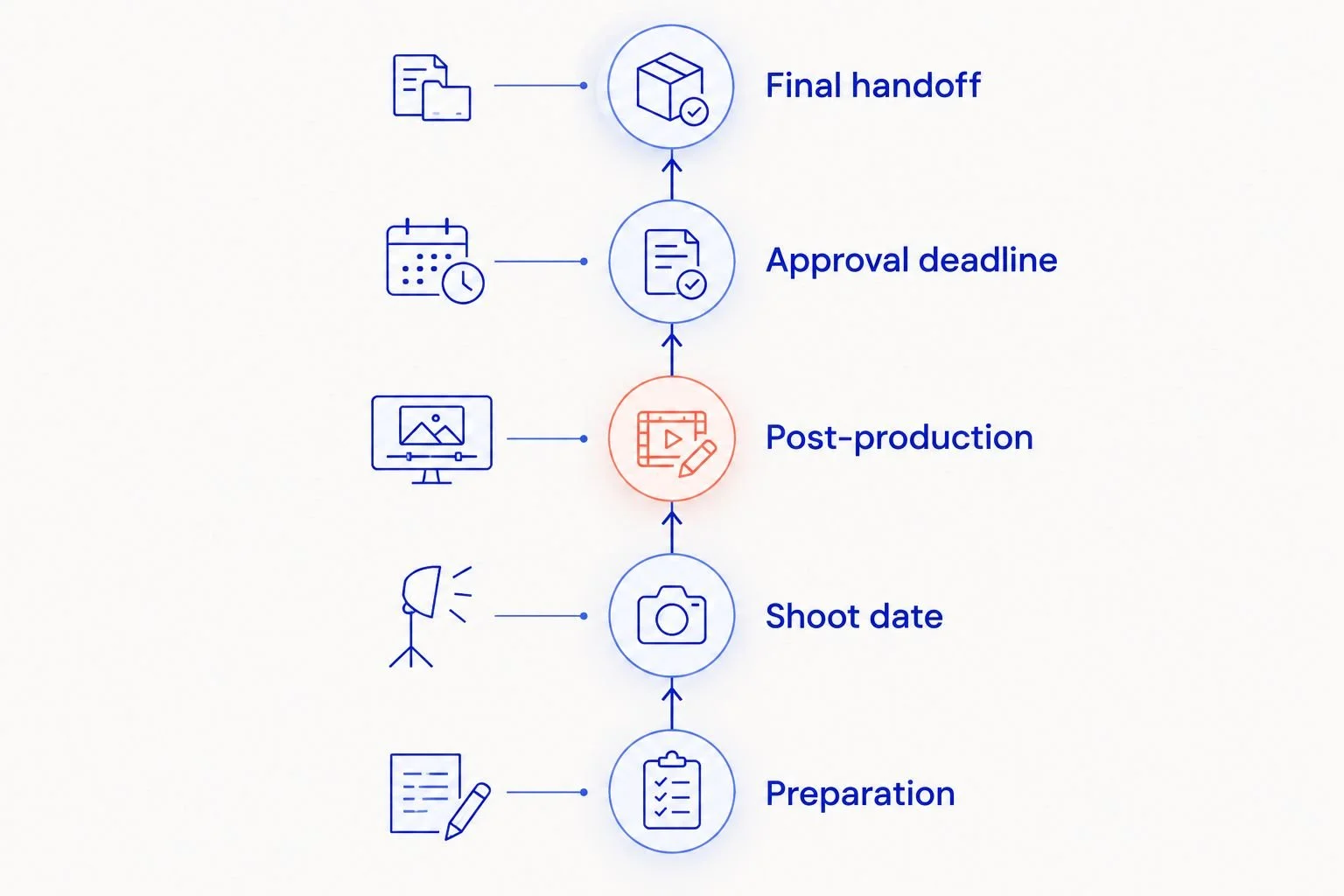
Set the final handoff first, then confirm the work that must happen before it.
Keep the agreed milestones in a shared document. If packaging changes or an approver requests additional images, revisit the affected stages instead of assuming the original delivery date still fits.
Match the booking plan to the photography brief
A product-listing refresh and a fragrance campaign should not inherit the same schedule simply because both involve bottles. Compare the work, not just the product count.
The approaches below are planning choices, not promised turnaround times. Choose the description that matches your brief, then ask the photographer to assess the production requirements.
Product-only listing images
Best for: Clearly defined packaging views and consistent catalog needs
Planning advantage: A specific shot list makes scope easier to communicate
Planning limitation: Additional variants, angles, or packaging changes still require review
Styled campaign still life
Best for: Skincare, cosmetics, or fragrance imagery built around a visual concept
Planning advantage: Creative references establish the intended campaign direction
Planning limitation: Styling and composition decisions need approval before production
Combined photography and video
Best for: Campaigns requiring still and motion deliverables
Planning advantage: A shared brief lets the team discuss both formats together
Planning limitation: Motion needs its own capture, editing, and review requirements
Best for a defined catalog refresh: begin with a precise product-and-angle list. The benefit is clarity; the limitation is that an incomplete list leaves the schedule unresolved.
Best for a concept-led campaign: establish the visual direction before locking the production plan. The benefit is a clear creative target; the limitation is the preparation required to reach it.
Best for a still-and-motion campaign: scope both formats at the outset. The benefit is coordinated planning; the limitation is that a photography schedule does not automatically cover video work.
Product-only photography: define every required view
For packaging-led work, send a product list that distinguishes sizes, shades, sets, and packaging versions. Identify which items need individual images and which need group compositions.
Then describe the required views. A front-facing pack shot, an open jar, and a texture image are different deliverables, even when they feature the same skincare product.
For your 2026 product-listing refresh, separate required launch assets from optional additions. Confirm the essential scope first; do not hide extra deliverables inside a general request for product photos.
Styled campaign photography: settle the concept before production
A campaign brief should explain what the image needs to communicate and where it will appear. Include relevant references, intended compositions, and any requirement to leave space for campaign copy.
Distinguish approved direction from ideas still under discussion. A reference board is useful, but the photographer also needs to know which elements are essential and which are open to interpretation.
Courtney Dailey Photography is best for beauty brands and agencies seeking luxury skincare, makeup, and fragrance campaign photography. That specialty is a reason to assess portfolio fit, not a substitute for agreeing on the creative scope and delivery schedule.
Photography and video: plan separate deliverables
If your launch needs motion, include it in the initial inquiry. Explain what the video must show, where it will run, and who will approve it.
Do not assume a still image and a video clip are interchangeable outputs. Ask for a schedule that identifies the preparation, capture, editing, and review requirements for each format.
Courtney Dailey Photography offers beauty and cosmetic product photography and video. For a combined brief, discuss both deliverable lists together while keeping their approval requirements explicit.
Why beauty photography booking timelines vary
The schedule depends on decisions and dependencies, not only the time spent behind the camera. Review these factors before asking a photographer to confirm a delivery deadline:
Product readiness. Specify when shoot-ready products and the correct packaging version will reach the production team. Flag prototypes or pending label changes.
Deliverable scope. List product views, group images, textures, campaign compositions, and motion requirements separately. Different outputs need different production decisions.
Creative preparation. Identify unresolved styling, background, prop, and composition choices. Assign someone to approve the direction.
Production coordination. State whether the brief includes product-only work, people, or additional collaborators. Confirm who coordinates each part.
Retouching requirements. Describe the intended finish and any product details that must remain accurate. Agree on the review process rather than assuming it.
Approval ownership. Name the people who must sign off and identify who consolidates their feedback. A schedule needs accountable reviewers.
For a 2026 campaign, put these details beside the corresponding milestone. That makes a delayed packaging decision or unresolved approval visible before it becomes a last-minute delivery problem.
What should I send before asking for a shoot date?
Send a short brief that lets the photographer understand the assignment without reconstructing it from scattered messages. Clear inputs make the scheduling discussion more useful.
Include:
Campaign purpose: a launch, listing refresh, fragrance campaign, or another defined use.
Product scope: the items, variants, packaging versions, and groupings to photograph.
Required imagery: essential views, textures, styled compositions, and any motion.
Creative direction: references plus a clear distinction between approved choices and open questions.
Delivery requirements: file specifications, intended placements, and the earliest approved-file handoff.
Review process: the final decision-maker and the person responsible for consolidated feedback.
Add the product-readiness date and explain which deadline is fixed. If your launch date is firm but the packaging date is not, state both facts directly.
Ask for a feasible production plan, not just a shoot date. The useful response connects preparation and delivery to the work you need.
Discuss your beauty photography brief
Share your skincare, makeup, or fragrance campaign scope and required image handoff.
Should I contact a photographer before my packaging is final?
Contact a photographer before packaging is final if you can clearly explain what remains unresolved. Share the current direction, expected product-readiness date, and required image handoff, but distinguish planning assumptions from approved production details.
An early conversation helps define the assignment. It does not make unfinished packaging ready to photograph or establish a delivery commitment by itself.
For a 2026 packaging launch, identify the exact version that must appear in the final images. Avoid asking the production team to infer whether a sample, label, cap, or carton represents the approved product.
What should I do if my launch deadline is close?
Prioritize the images your launch cannot proceed without, then ask the photographer to assess that defined scope. Separate essential product views from additional campaign concepts rather than presenting every idea as equally urgent.
Be explicit about trade-offs. Reducing scope changes what you receive; moving the image handoff changes the downstream calendar. Neither decision should happen silently.
Do not remove review time from the plan to make the dates look workable. Confirm who will review the images and when before accepting the schedule.
FAQ
How far in advance should I book a beauty product photographer?
Book once you can define the assignment, product-readiness date, and approved-file deadline, then agree on a backward-planned schedule. Preparation, photography, retouching, and approvals all belong in that plan; a fixed number of weeks does not describe every brief.
Should I book beauty photography before my products arrive?
Start the planning conversation before products arrive if you can provide a reliable readiness date and explain any unresolved packaging details. Confirm how product delivery affects preparation and the agreed shoot schedule.
Is the shoot date the same as the image delivery date?
The shoot date is not the final image delivery date. Image selection, agreed retouching, review, and file delivery need their own place in the production schedule.
What information does a beauty photographer need to plan a shoot?
A beauty photographer needs the product scope, required imagery, creative direction, product-readiness date, and final handoff requirements. Include who approves the work and which deadline is fixed.
Can I add video to a beauty product photography booking?
Discuss video before confirming the scope and schedule rather than assuming it is covered by a still-photography brief. Courtney Dailey Photography offers beauty and cosmetic product photography and video; agree on the specific motion deliverables during planning.
How do I plan photography for a 2026 beauty launch?
Plan photography for a 2026 beauty launch backward from the earliest approved-file handoff. Confirm preparation, capture, post-production, and review milestones with the people responsible for completing them.
One last thing
Your earliest image deadline might belong to someone other than the launch team. Ask your designer, retailer contact, and production partners when they need approved files before you name the photography deadline.
Put the receiving team's handoff date in the brief, not just the public launch date. That distinction gives your photographer a usable target and keeps the booking discussion focused on finished work.