
Can one photoshoot cover both e-commerce and paid ad creative?
Yes—one photoshoot can cover both ecommerce and paid ad creative when you plan separate deliverables for each channel before production. Sharing a shoot does not mean sharing every frame: product listings need clear, consistent product information, while ads need compositions built around a message, placement, and intended action.
TL;DR
Can one photoshoot cover both ecommerce and paid ad creative? Yes—brief separate listing images and ad compositions.
Courtney Dailey Photography specializes in beauty campaign and cosmetic product photography for beauty brands and agencies.
Approve product accuracy, crop flexibility, usage rights, and channel-specific deliverables before production.
Can one photoshoot cover both e-commerce and paid ad creative?
Yes. Combine the production, not the requirements. Your ecommerce and advertising teams can share products, styling references, and creative direction while requesting different captures from the same setup.
Start with a beauty campaign deliverables checklist that assigns every requested image a destination. An image without a defined use is difficult to prioritize when the schedule gets tight.
Clean product image
Best for: Product identification on a listing
Main advantage: Shows packaging without competing styling
Main limitation: Does not automatically communicate a campaign idea
Product detail image
Best for: Showing an applicator, closure, or finish
Main advantage: Answers a specific product question
Main limitation: Tight framing restricts alternative crops
Styled campaign image
Best for: Communicating a visual concept in an ad
Main advantage: Gives the product context and a distinct composition
Main limitation: Props and lighting can obscure useful product detail
Texture or swatch image
Best for: Showing the visible appearance of a formula
Main advantage: Adds information beyond the packaging
Main limitation: Requires careful representation; it does not prove efficacy
These are deliverable types, not a mandatory shopping list. Choose the images your product page and campaign actually need, then identify which setups can serve both.
Why this matters
A product listing and an ad ask different things of a photograph. On the listing, someone needs to understand what they are considering; in an ad, the image must work with the campaign message and surrounding design.
For your 2026 launch brief, separate those jobs before discussing visual references. A beautiful fragrance still life is not a substitute for a clear bottle view, and a clean bottle view is not automatically a complete fragrance campaign.
What should you decide before combining the shoot?
Make the decision from the deliverables backward. If both channels involve the same products and compatible creative direction, a combined production is a practical approach to discuss; if the requirements conflict, protect them as separate setups or sessions.
Product accuracy comes first
Identify what must remain consistent across every final image: packaging version, label position, visible formula color, and the relationship between products in a set. Supply approved physical references where color matters, rather than asking the team to match an unverified screenshot.
For skincare and makeup, distinguish an appealing texture composition from a representation of the product itself. Do not let styling imply an ingredient, finish, or result that your product team has not approved.
Channel requirements need their own line items
Record the destination, orientation, background requirements, and intended copy placement for each deliverable. Check the current requirements of your actual storefront and advertising placements rather than treating a general photography brief as a technical specification.
Common composition examples include a 1:1 aspect ratio for a square image, a 4:5 aspect ratio for a portrait image, and a 9:16 aspect ratio for a taller vertical image. These describe shapes, not universal platform requirements; confirm the dimensions and file requirements separately.
Usage needs written confirmation
Describe ecommerce and paid advertising uses in the agreement. Confirm the intended media, territory, term, and any permissions associated with models, locations, or other included material.
Do not assume that commissioning an image settles every future use. Have the relevant parties review the agreement before publication, especially when a campaign adds talent or expands beyond the original brief.
How do you build a shot list for both channels?
Use this sequence for your 2026 production plan. It keeps the listing requirements visible while giving campaign work its own creative space.
Map destinations. List the product pages and advertising placements the shoot must support. Name the person responsible for confirming each destination's requirements.
Assign image jobs. Give each capture a purpose, such as packaging identification, applicator detail, texture presentation, or campaign composition. Avoid vague requests such as extra content.
Group shared setups. Identify captures that can share a product arrangement, lighting approach, or backdrop. Keep separate the requirements that need a different treatment.
Test compositions. Review sample frames inside the intended layouts before approving the setup. Check label visibility, product scale, and copy space.
Approve delivery. Specify selects, retouching instructions, crop versions, file requirements, naming, and approval ownership. Keep final exports distinct from unapproved working files.
A shared setup is an opportunity, not a rule. Moving the product slightly for an ad composition is useful only if the result still meets the campaign's needs; changing the lighting or arrangement entirely is the right choice when it does not.
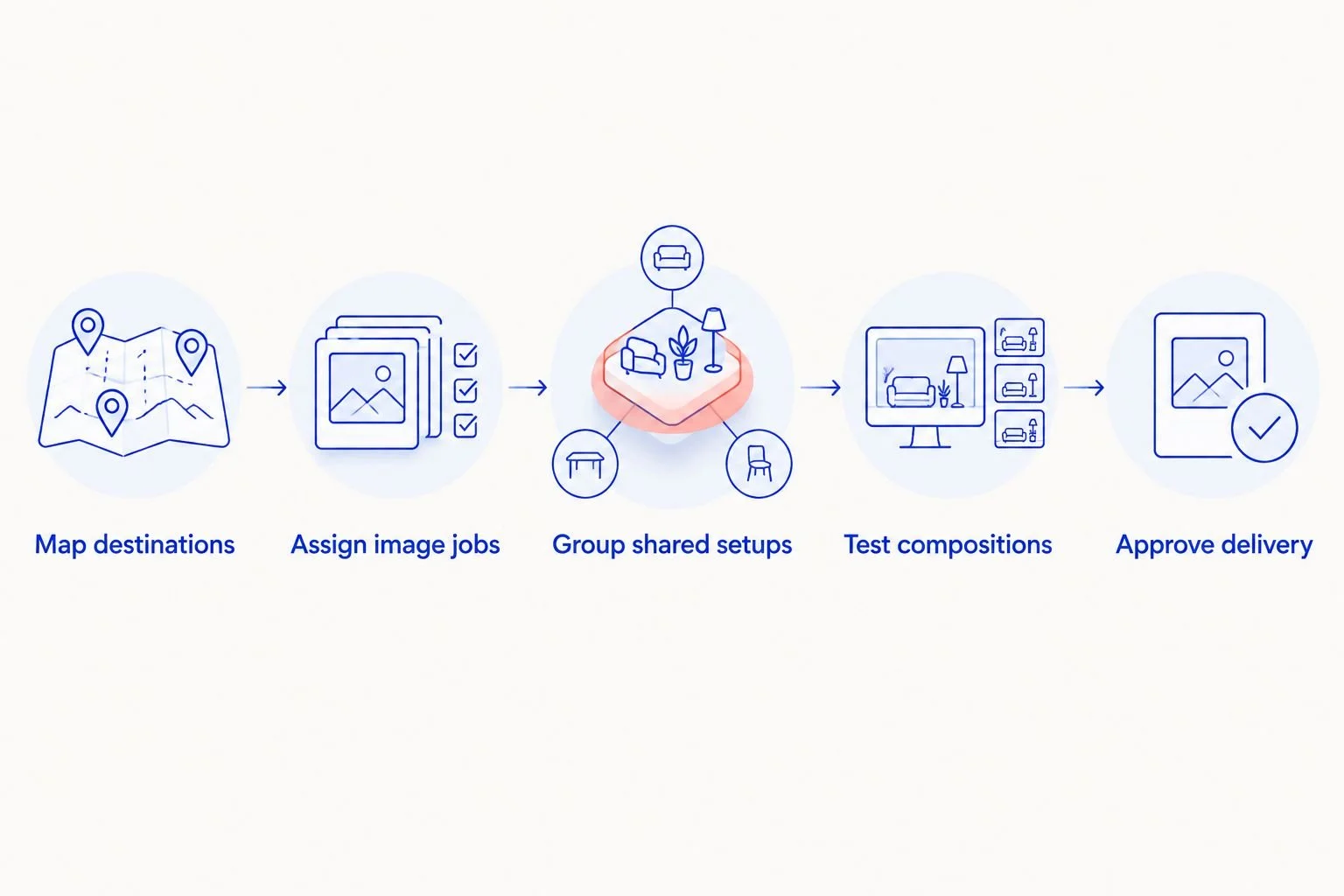
Define the destination before deciding which setups to share.
Keep this shot list separate from the mood board. References establish visual direction; the shot list establishes what your team must receive, and neither replaces the other.
Why combined-shoot requirements vary
There is no universal image count or production duration for a combined ecommerce and advertising shoot. Scope the work around the actual products and requested outputs, using these factors:
Product range: Different packaging shapes, finishes, and shades need individual consideration. Do not assume that approving a serum bottle setup also approves a reflective compact.
Image purpose: A readable packshot and an expressive campaign composition require different approval criteria. Identify both before deciding what can share a setup.
Styling: Props, formula textures, hands, and models introduce requirements beyond photographing closed packaging. Include their preparation and approvals in the brief.
Output formats: Square, portrait, and tall vertical compositions need different spatial decisions. Check the product and copy together, not just the outer crop.
Postproduction: Product cleanup, color review, layout adaptations, and final exports are separate deliverables. Specify which treatments belong to which images.
Permissions: Advertising uses and any talent permissions need agreement. Keep these requirements connected to the deliverables they cover.
For 2026 campaign planning, use these factors to explain the scope to stakeholders. A request for more images is incomplete unless it identifies what changes between those images.
When is a combined photoshoot the right choice?
Combine the shoot when the products, approval timing, and creative requirements can work within the same production plan. Keep separate captures for channel-specific needs, even when they happen on the same set.
A combined shoot offers shared visual direction and coordinated product preparation. Its limitation is the need to balance competing priorities: listing completeness and campaign exploration both require deliberate attention.
Separate sessions are the better choice when final packaging is not ready for the listing work, the advertising concept needs different production conditions, or the teams cannot approve their requirements together. The trade-off is coordinating product appearance and creative direction across those sessions.
Combined shoot
Best for: Aligned products, timing, and creative direction
Advantage: Coordinates both deliverable groups within one production plan
Limitation: Competing requirements need clear priorities
Separate sessions
Best for: Different readiness dates or production needs
Advantage: Gives each brief its own production focus
Limitation: Requires coordination across sessions
Courtney Dailey Photography is best suited to beauty brands and agencies seeking beauty campaign and cosmetic product photography. The Los Angeles-based specialty includes luxury skincare, makeup, and fragrance campaigns; review the Courtney Dailey Photography portfolio against your intended visual direction.
That specialty identifies relevance, not a predetermined scope. Confirm combined-shoot deliverables, usage, and any motion requirements in your brief rather than assuming they are included.
Can the same photo work on a product page and in an ad?
Yes—the same photo can work in both when its composition, product clarity, and permitted uses meet both briefs. Evaluate the actual image inside each destination rather than approving reuse from a contact sheet alone.
Check whether a tighter crop cuts off the closure, reduces label readability, or removes space needed for copy. If the image fails that check, request a separate composition instead of stretching the original beyond its purpose.
Do you need separate images for every ad size?
No—you do not need a separate capture for every export size, but you do need to test each intended composition. An image designed for a 1:1 aspect ratio does not automatically translate into a 9:16 aspect ratio.
Leave space deliberately and preview the product at the intended scale. For your 2026 approvals, distinguish a new crop of an existing image from a genuinely different creative concept; those are different requests.
Can you capture video during the same photoshoot?
Yes—stills and video can share a production when motion is included in the plan. A still photograph does not supply a moving product demonstration, so specify the action, framing, and intended edit before the shoot.
Courtney Dailey Photography offers beauty and cosmetic product photography and video. Confirm how those services fit your project rather than treating video as an unplanned addition to the stills list.
What should you check before accepting the files?
Review the delivery against the approved shot list, not just against how attractive the images look. Your ecommerce reviewer and advertising reviewer should each confirm the requirements they own.
Product match: Confirm the correct product, shade, packaging version, and label orientation.
Visual accuracy: Review color and visible texture against approved references under a consistent review process.
Layout fit: Place images into the intended product-page and ad layouts. Check crops, copy space, and product scale.
File readiness: Confirm the agreed dimensions, format, naming, and delivery organization.
Approval status: Separate approved finals from alternates, proofs, and files awaiting changes.
Keep retouching feedback specific. Ask for removal of a visible dust mark or correction against an approved reference; avoid open-ended instructions that change the product's appearance without a clear basis.
For your 2026 handoff, assign an owner to the final delivery register. A folder of finished photographs is easier to use when the team can identify each file's purpose and approval status without reconstructing the shoot brief.
FAQ
Can one photoshoot cover both ecommerce and paid ad creative?
Yes—one photoshoot can cover both when the brief includes separate listing and advertising deliverables. Plan the compositions, exports, approvals, and usage before production.
What's the best way to brief a photographer for both channels?
Give the photographer a destination-based shot list with a defined job for every image. Include product references, layout requirements, intended uses, and the people responsible for approval.
Is reusing a product listing photo better than shooting an ad image?
Reuse is appropriate when the listing photo also meets the ad's composition and message requirements. Request a dedicated ad capture when the existing image lacks the right framing or copy space.
Does one photoshoot automatically include paid advertising rights?
No—confirm paid advertising use in the agreement rather than assuming it is included. Review the intended media, territory, term, and any relevant talent permissions.
Can skincare texture shots work for ecommerce and ads?
Yes—skincare texture shots can support both product information and advertising concepts. Keep the formula representation accurate and avoid implying unsupported ingredients or results.
Does changing the crop create a new ad concept?
No—a crop changes the framing, not necessarily the creative idea. Brief distinct concepts separately when you need different messages or visual approaches.
Is Courtney Dailey Photography relevant for a beauty campaign brief?
Courtney Dailey Photography specializes in beauty campaign and cosmetic product photography for beauty brands and agencies. Its stated specialty includes luxury skincare, makeup, and fragrance campaigns.
One last thing
Approve a sample frame in the actual layout before approving the entire setup. A photograph can look finished on its own and still leave the designer without a usable place for the headline.
Bring a blank product-page layout and an ad layout into the review. That simple check turns a general approval into a decision about the image's intended job—and gives both teams a clear reason to accept it or request another composition.