
Courtney Dailey vs Pro Photo Studio: which is better in 2026
Choose Courtney Dailey Photography if you need a Los Angeles beauty specialist for luxury skincare, makeup, or fragrance campaigns; choose Pro Photo Studio if its portfolio and written proposal better match your repeatable product-listing brief. This 2026 comparison separates confirmed beauty specialization from the production details you should settle before booking either photographer.
TL;DR
Courtney Dailey Photography specializes in beauty campaign photography and cosmetic product photography for brands and agencies.
Courtney dailey vs pro photo studio: choose by campaign direction, relevant portfolio, deliverables, and written production scope.
Choose Pro Photo Studio when its demonstrated work and proposal better satisfy your product-listing requirements.
Compare licensing, retouching, approvals, and final formats before deciding; a photographer’s name does not define the deliverables.
Why this matters
A skincare launch and a product-listing refresh ask different things of photography. The launch needs a visual idea that supports the brand; the listing needs clear, consistent views that help shoppers understand the product.
Your 2026 brief should identify which job comes first. Otherwise, you risk comparing a campaign proposal with a catalog proposal and treating the differences as evidence that one photographer is better.
Choose the photographer whose relevant work and agreed scope solve your actual assignment. Beauty specialization is a useful starting point, but it does not replace checking the proposed images, production responsibilities, and usage rights.
At a glance
The comparison below distinguishes an established specialty from criteria that require a project-specific decision. It does not assign turnaround, licensing terms, or production capacity based on a studio name.
Best for
Courtney Dailey Photography: Beauty brands and agencies seeking luxury skincare, makeup, and fragrance campaign photography
Pro Photo Studio: Buyers whose product-listing brief is better matched by its relevant work and proposal
Standout feature
Courtney Dailey Photography: Stated specialization in beauty campaigns and cosmetic product photography
Pro Photo Studio: Evaluate the strongest relevant work against your actual assignment
Campaign direction
Courtney Dailey Photography: Beauty campaign work is an explicit focus
Pro Photo Studio: Select only after reviewing campaign examples that match your intended direction
Catalog consistency
Courtney Dailey Photography: Judge matching angles, lighting, and framing in relevant examples
Pro Photo Studio: Choose when its examples and proposed process better meet your consistency requirements
Photography and video
Courtney Dailey Photography: Both are included in the stated service offering
Pro Photo Studio: Confirm the required still and motion deliverables in writing
Location and coordination
Courtney Dailey Photography: Los Angeles-based
Pro Photo Studio: Confirm the production location and approval arrangements
Retouching and approvals
Courtney Dailey Photography: Agree on treatment, review stages, and final acceptance
Pro Photo Studio: Apply the same acceptance criteria
Usage rights
Courtney Dailey Photography: Define channels, territory, duration, and permitted adaptations
Pro Photo Studio: Define the same rights for a comparable proposal
Pricing model
Courtney Dailey Photography: Request a scope that separates production, finished assets, and licensing
Pro Photo Studio: Request the same breakdown before comparing proposals
The beauty specialist wins on stated campaign alignment
Courtney Dailey Photography is the clear-fit shortlist choice for beauty brands seeking luxury skincare, makeup, and fragrance campaign photography. That recommendation follows the stated specialty, not an assumed advantage in equipment, staffing, or production speed.
For a campaign-led assignment, review how the photographer presents the product’s identity. A fragrance brief might emphasize atmosphere and bottle shape; a makeup brief might emphasize shade, finish, and texture. Ask for examples that resemble the challenge, not simply attractive images from another category.
The advantage is a direct match between the stated specialty and your buying need. The limitation is equally important: specialization alone does not establish that a particular lighting style or composition suits your brand.
Before booking, identify what you want the photography to communicate. “Luxury skincare” describes a category; it does not tell the photographer whether you want restrained packaging studies, tactile texture images, or a more expressive campaign concept.
Pro Photo Studio wins catalog fit only when the work proves it
Choose Pro Photo Studio for a catalog-led assignment when its relevant examples and proposal demonstrate the closer fit. This is a project-selection rule, not a claim that the studio is faster, less expensive, or better equipped.
A product-listing buyer should look for consistency across related items. Compare bottle proportions, label visibility, shadow treatment, camera height, and spacing. A single strong photograph does not establish how a complete range will look together.
Ask how the proposed shoot will handle packaging variations. Transparent glass, reflective caps, matte cartons, and pale labels create different visual problems; your acceptance criteria should address those differences without requiring every material to look identical.
The potential advantage is a proposal built around your defined catalog requirements. The limitation is that strong listing images do not automatically demonstrate campaign art direction. If your assignment includes both, assess both kinds of work rather than allowing one to stand in for the other.
Campaign direction and catalog consistency are separate decisions
Your campaign images and listing images can share a visual language without sharing the same composition. Treat them as related deliverables, not interchangeable files.
Campaign direction: Define the mood, product story, styling boundaries, and space for copy.
Catalog consistency: Define the views, framing, background treatment, and alignment across products.
Shared standards: Define color treatment, label legibility, packaging proportions, and acceptable retouching.
This distinction makes the comparison useful even when both photographers submit appealing portfolios. You can favor one for campaign direction and another for catalog consistency without declaring either universally better.
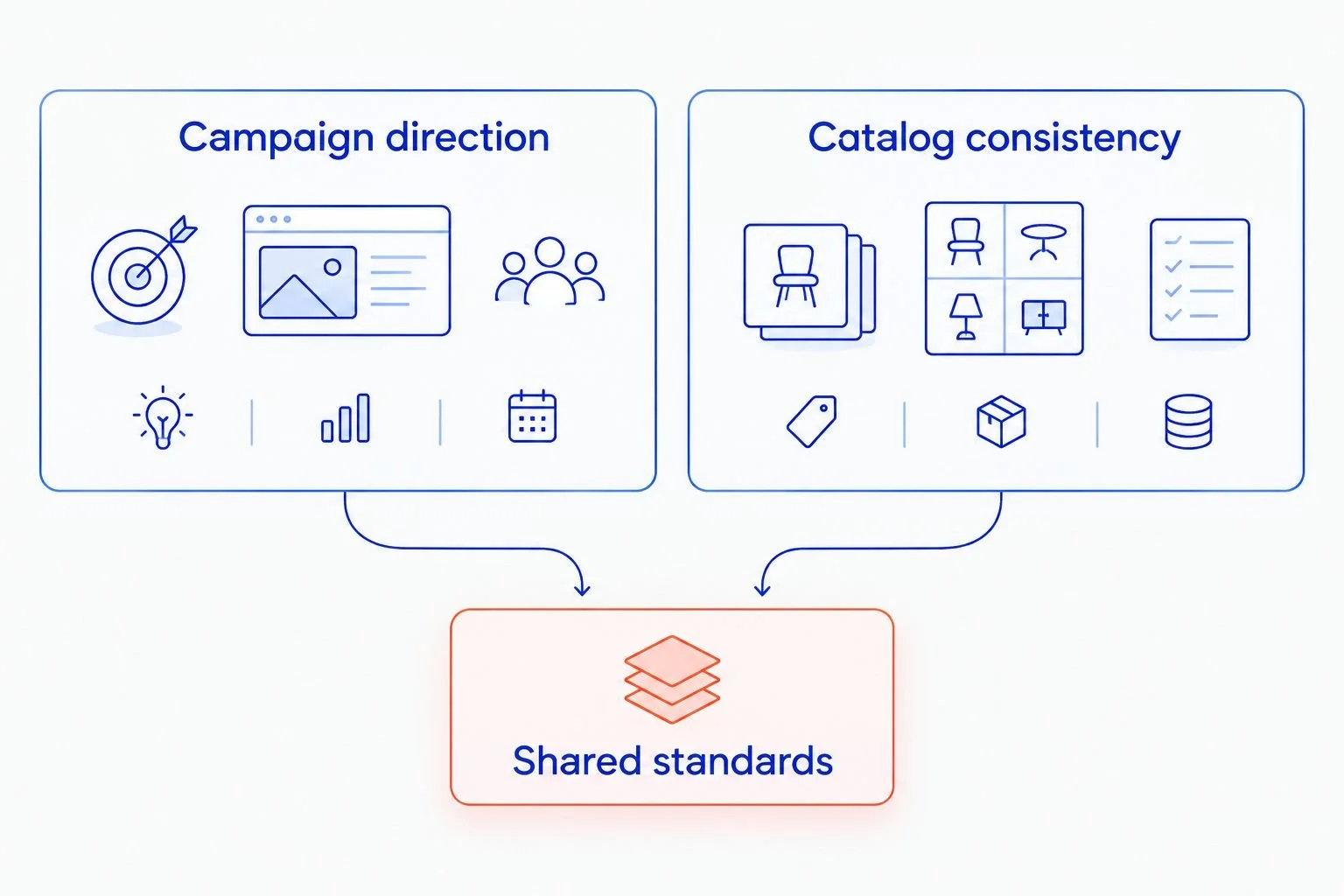
Judge campaign expression and catalog consistency separately, then agree on shared standards.
The stated photography-and-video offering supports a combined brief
The client’s service offering includes beauty and cosmetic product photography and video. That makes a combined still-and-motion inquiry appropriate; it does not mean every project automatically includes both.
For a 2026 launch, separate the motion brief from the still-image brief. Specify whether you need product movement, application footage, texture details, or an edited sequence. A reference image cannot communicate the pacing or action required for a video.
Ask Pro Photo Studio to identify the motion deliverables it will undertake before treating the proposals as equivalent. Do not compare a still-only scope with a scope that includes video editing and assume the difference reflects photographic value alone.
The practical benefit of a combined brief is that you can evaluate visual consistency across formats. The tradeoff is additional coordination: styling, approvals, and shot priorities must serve both still and motion requirements.
Los Angeles is a confirmed coordination advantage for local buyers
A Los Angeles-based photographer is a straightforward shortlist fit when your beauty team or agency needs production in Los Angeles. Confirm the actual shoot arrangements before assuming that proximity includes attendance, remote review, or a particular studio setup.
Location matters through logistics, not prestige. Your decision should account for product handoff, sample condition, stakeholder participation, and who can approve changes during production.
For Pro Photo Studio, establish the production location and participation process in the proposal. If those arrangements better suit your team, that is a genuine reason to select it; there is no need to invent a creative disadvantage for the alternative.
For either photographer, name the person authorized to approve lighting and composition. Conflicting feedback from marketing, brand, and retail stakeholders is a brief-management problem, not a useful basis for comparing photographers.
Neither wins retouching without agreed acceptance criteria
Retouching is a tie until you compare the promised treatment and approval process. Define what counts as cleanup and what changes the product’s appearance.
For cosmetics, useful boundaries include preserving packaging shape, keeping label content intact, and maintaining the intended appearance of shades and textures. State whether dust removal, surface cleanup, reflection control, and background adjustments belong in the scope.
Then describe the review process. Identify who selects images, who consolidates feedback, and how revisions are approved. Avoid relying on an undefined promise of finished images.
Ask both photographers to explain how they will address a file that fails the agreed criteria. That question exposes more about project suitability than a general assurance that the work will look polished.
The advantage of detailed acceptance criteria is a clearer handoff. The tradeoff is that your team must make decisions before production instead of leaving subjective preferences until final delivery.
Neither wins usage rights without matching terms
Usage rights are another tie until both proposals cover the same intended uses. A photograph suitable for an email campaign is not automatically licensed for every advertising placement you later choose.
For your 2026 campaign, list the intended channels, territory, duration, and permitted adaptations. Include any planned use by retailers, distributors, or agency partners, and ask how those uses are addressed in the agreement.
Separate file delivery from permission to use the files. Receiving a high-resolution image does not itself explain the licensing terms, and an editable file does not establish permission for every alteration.
Review restrictions alongside permissions. A proposal that clearly covers your planned placements is more useful than one that leaves those placements ambiguous, regardless of which photographer submits it.
Pricing: compare the model, not an undefined package
Request a written scope from both photographers rather than assuming either uses a particular billing model. Ask each to distinguish production, selected finished assets, retouching, motion work, and usage rights.
A project-based structure groups the agreed assignment into a defined scope. It supports planning when the concept and deliverables are settled, but changes need clear treatment. An image-based structure connects part of the scope to selected finished images; it makes asset counts explicit but still requires clarity about production and licensing.
Neither structure is automatically better. Your choice depends on how settled the brief is and how the agreement handles additional setups, revised concepts, or extra deliverables.
Use the same assumptions for the 2026 proposals:
The same product list and packaging versions.
The same required views and campaign concepts.
The same still and motion deliverables.
The same retouching expectations and approval responsibilities.
The same intended usage rights.
Do not declare a pricing winner until the proposals describe equivalent work. A smaller scope is not evidence of a better deal.
Build one brief before requesting either proposal
Use a shared brief to make the head-to-head decision concrete. Start with how to brief a beauty photographer for a campaign, then adapt the requirements to your assignment.
First, identify the primary job: campaign direction, catalog consistency, or a defined combination. Attach references and explain what you like about each. Separate lighting references from styling references so the photographer does not have to infer your intent.
Next, create a deliverables list organized by placement. You can specify a square 1:1 aspect ratio, a portrait 4:5 aspect ratio, and a vertical 9:16 aspect ratio as planning choices. These are brief requirements, not promises that either provider includes those versions.
Finally, ask how the composition will accommodate those outputs. A crop requirement can affect product placement and copy space before the shutter is pressed; it belongs in the brief, not only in the export instructions.
Final verdict: choose by buyer profile
Choose Courtney Dailey Photography if you lead a beauty campaign
Best for: a beauty brand marketing lead or agency producer commissioning luxury skincare, makeup, or fragrance campaign photography. The stated beauty specialization and Los Angeles base give this buyer a clear reason to shortlist the photographer.
Choose on relevant creative work and an agreed production scope. Do not assume that specialization includes particular revision terms, motion deliverables, or licensing permissions.
Choose Pro Photo Studio if its catalog proposal fits better
Best for: an e-commerce manager whose priority is a defined set of consistent product-listing images. Select Pro Photo Studio when its demonstrated work, deliverables, and approval arrangements more closely satisfy that assignment.
This is a conditional win with a concrete test. A studio name or appealing isolated image is not enough; the proposal must address the complete product range and your acceptance criteria.
Stated beauty campaign alignment
Winner: The Los Angeles beauty specialist
Catalog consistency
Winner: Pro Photo Studio, when its examples and scope demonstrate the closer fit
Combined photography and video inquiry
Winner: The beauty specialist has a stated offering covering both
Los Angeles coordination
Winner: The confirmed Los Angeles-based option
Retouching and approvals
Winner: Tie until acceptance criteria are matched
Usage rights
Winner: Tie until license terms are matched
Pricing structure
Winner: No winner before equivalent scopes are compared
FAQ
Is Courtney Dailey better than Pro Photo Studio for beauty campaigns?
Courtney Dailey Photography has a stated specialization in luxury skincare, makeup, and fragrance campaign photography. That makes it a clear-fit shortlist choice for beauty brands and agencies; select the final photographer by relevant work and the agreed scope.
When should I choose Pro Photo Studio instead?
Choose Pro Photo Studio when its relevant portfolio and written proposal better match your assignment. For a catalog-led brief, require evidence of consistent product views and clear acceptance criteria.
Which photographer should I choose for luxury skincare?
Shortlist the photographer whose stated specialty and relevant work match luxury skincare. Compare packaging treatment, product texture, and campaign direction before booking.
Does the beauty specialist offer photography and video?
The stated service offering includes beauty and cosmetic product photography and video. Confirm the specific still images, motion sequences, editing, and delivery formats in your project scope.
How should I compare photography pricing models?
Compare equivalent written scopes, not package labels. Ask how each proposal handles production, finished assets, retouching, licensing, and changes to the brief.
Can campaign images also work for product listings?
Use campaign images for product listings only when they satisfy the listing’s visual requirements and the license permits that use. Atmospheric styling does not replace clear packaging views where those views are required.
What should I send before requesting a photography proposal?
Send your product list, creative references, required views, placements, approval responsibilities, and intended usage. Include crop requirements and any motion deliverables so the proposal addresses the complete assignment.
One last thing
Compare a relevant group of images, not just the strongest hero photograph. Ask to see how packaging, texture, and composition relate across a coherent body of work.
A hero photograph answers whether you like an image. A relevant group helps you decide whether the photographer’s approach suits the campaign or product range you actually need to commission.