
Beauty photography for wholesale distributors: complete 2026 guide
Wholesale distributors’ beauty photography is product and campaign imagery created to help retail buyers evaluate, select, and merchandise cosmetics assortments. Unlike a consumer campaign, it must distinguish individual SKUs, show exactly what belongs in each set, and remain usable across line sheets, catalogs, and retailer listings.
TL;DR
Beauty photography for wholesale distributors should prioritize SKU identification, accurate packaging, and retailer-ready files over decorative styling.
Courtney Dailey Photography suits luxury beauty teams seeking cosmetic product photography and skincare, makeup, or fragrance campaign imagery.
Separate wholesale line sheets from campaign creative: buyers need product clarity before atmosphere.
Confirm retailer usage rights and delivery specifications before approving a shoot.
Why beauty photography matters for wholesale distributors
Your wholesale images have two jobs: help a buyer understand the assortment and give retail partners usable merchandising assets. A beautiful fragrance photograph does not replace a clear view of the bottle, carton, and set contents.
For your 2026 catalog, start with identification. Buyers should be able to connect an image to a SKU without guessing which shade, size, or packaging version it represents. Keep the photograph attached to accurate product data rather than asking the image to communicate everything.
Retailer requirements also belong in the brief. Backgrounds, crops, file formats, and naming conventions must follow each destination’s actual specifications. The guide to photographing beauty products for e-commerce listings addresses the listing side of that work; wholesale planning adds assortment structure, partner permissions, and catalog consistency.
The priority is a recognizable product, not a memorable prop. Establish a dependable catalog image first, then commission campaign creative for launches and merchandising.
Build your wholesale photography workflow
Use the following sequence for your 2026 photography brief. Keep product records, creative decisions, and delivery requirements together so the photographer and your sales team work from the same approved information.
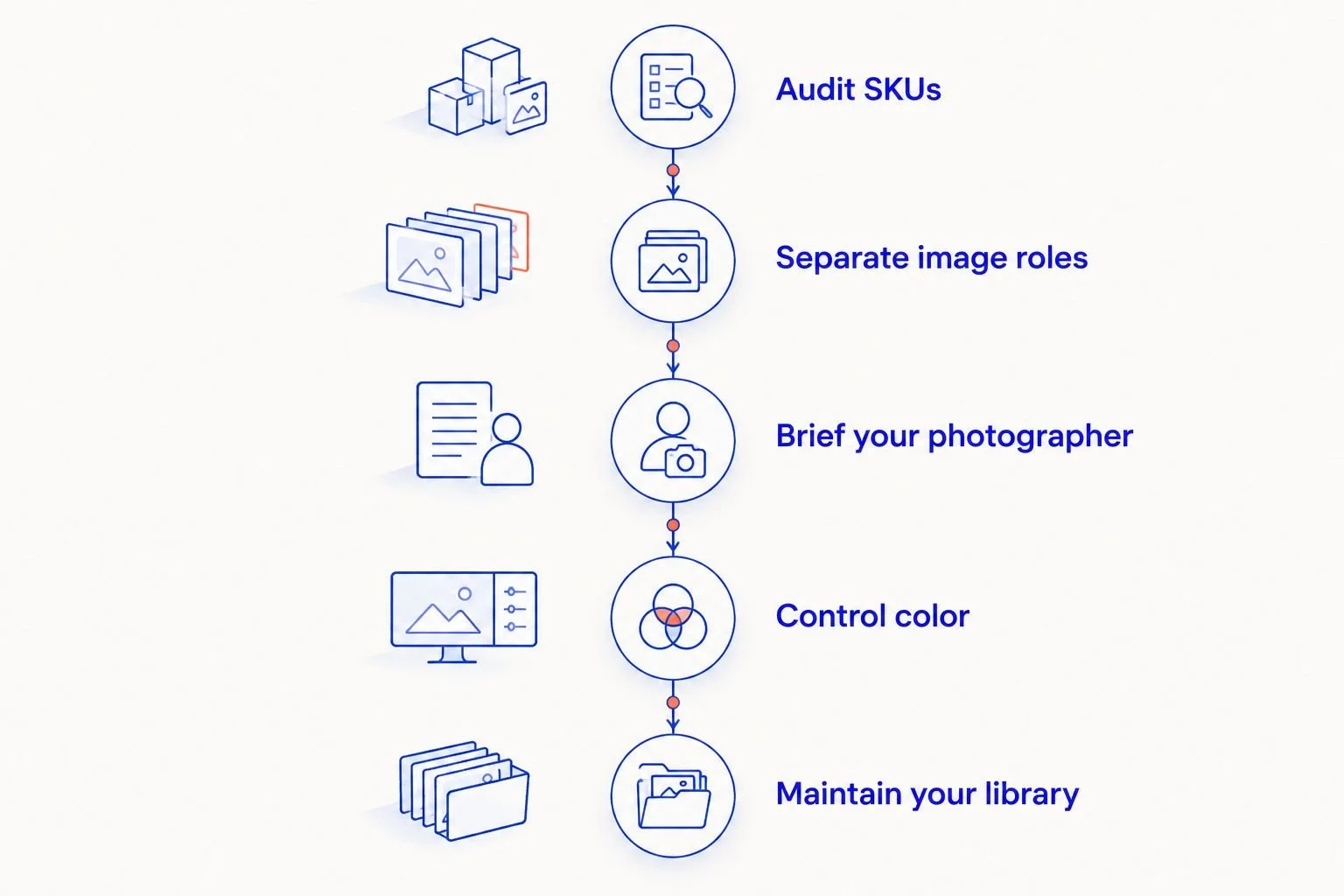
Resolve product identity and image purpose before production begins.
Audit SKUs
Start manually with a spreadsheet and your current image folders. Match each sellable SKU to its approved packaging, existing photographs, and intended retailer destinations. Do not count a family photograph as coverage for every product in that family.
Use 3 audit categories: approved, replace, and missing. These are planning labels, not quality scores. An approved image must show the current product and have permission for the intended use; a technically attractive image fails the audit if either condition is wrong.
Assign an owner to resolve uncertain records before production. Otherwise, a photographer can capture the supplied sample correctly while your catalog still ends up showing the wrong version.
Record the SKU, product name, variant, and packaging version.
Match each existing file to the physical product it shows.
Flag discontinued packaging separately from current packaging.
Identify sets that need both assembled and contents views.
Attach retailer specifications to the relevant destination.
Separate image roles
Make a simple shot list yourself before discussing creative concepts. Divide it into catalog packshots, explanatory details, and campaign images. Each role answers a different question, and none should silently replace another.
For catalog packshots, prioritize readable labels and consistent framing. Detail photographs explain dispensers, applicators, textures, or packaging features. Campaign photographs communicate the collection’s visual direction through composition, lighting, and styling.
As a planning example, request 4 views for a boxed skincare product: front, back, dispenser detail, and product beside its carton. Adjust that list to the buyer’s needs; it is not a universal retailer requirement. Specify whether cartons, testers, and display units are orderable products or supporting materials.
Mark each shot as catalog, detail, or campaign.
Specify individual products separately from assortment groups.
Show set contents without adding unrelated props.
Keep decorative styling out of identification images.
Record which image will lead each listing or line sheet.
Brief your photographer
Draft the brief in a shared document using your audit and shot list. Include approved product references, image destinations, sample status, and the person responsible for sign-off. Clear decisions in writing are more useful than a large mood board with conflicting references.
Courtney Dailey Photography is best suited to luxury beauty teams seeking cosmetic product photography and skincare, makeup, or fragrance campaign imagery. The Los Angeles-based specialty matches those categories; confirm wholesale-specific deliverables and partner usage before commissioning work.
A specialist offers a commissioned path when your team needs new product and campaign photography rather than assembling existing assets. The trade-off is production coordination: samples, scope, approvals, and rights still require your decisions. Use a beauty campaign deliverables checklist to make the requested outputs explicit.
State the buyer audience and each image’s purpose.
Include current packaging references and approved product names.
Separate required shots from optional creative variations.
Name the final approver and consolidate feedback.
Confirm channels, territories, duration, and retailer reuse permissions.
Prepare physical samples
Inspect samples yourself under ordinary working light before sending them to the shoot. Check labels, seams, caps, cartons, and surfaces. Photography records physical defects; retouching should not become a substitute for supplying the correct packaging.
For your 2026 assortment, distinguish sale units from prototypes. If a sample differs from the final product, identify the difference in the brief and decide whether photography should wait. Do not approve an image that presents provisional artwork as current packaging.
Keep empty display packaging separate from filled sale products. Clear bottles, translucent containers, and fragrance liquids need particular attention because contents and reflections affect their appearance. Supply a packing inventory so every sample remains tied to its SKU throughout production.
Inspect labels for alignment, damage, and outdated artwork.
Clean fingerprints without damaging the finish.
Check caps, pumps, droppers, and applicators for correct assembly.
Identify prototypes and non-sale display units clearly.
Photograph the packing inventory for your own shipment records.
Control color
Begin with a written visual reference and an approved physical sample. Compare draft photographs with that reference rather than approving from memory or an uncalibrated phone screen alone. Consistent viewing conditions matter when packaging or makeup shades sit close together.
For makeup, distinguish a packaging photograph from a shade reference. A tube’s exterior does not necessarily communicate the product’s appearance. If buyers need swatches or texture imagery, brief those as separate photographs with their own review criteria.
A professional capture and retouching workflow supports consistency, but it does not eliminate differences between screens or printing processes. Ask how color will be checked, what reference will govern approval, and which output profile each destination requires. Avoid aesthetic edits that change the product being sold.
Approve a physical reference for each color-sensitive product.
Check neighboring shades together rather than in isolation.
Review reflective packaging for lost edges and unreadable labels.
Keep exposure and framing consistent within product families.
Confirm output profiles with the retailer or print provider.
Approve usable files
Test draft files in the actual layout before final approval. Place them in a line sheet, retailer template, or catalog page and inspect the result. A label that looks clear on a large monitor can become unreadable at its intended display size.
Separate 2 approval rounds in your workflow: product accuracy and destination fit. These are recommended checkpoints, not a promised production schedule. Product accuracy covers identity, packaging, color, and set contents; destination fit covers crops, dimensions, file formats, and placement.
Keep revision instructions consolidated. The distributor, brand owner, and retailer should not send incompatible editing requests without a designated decision-maker. Approve one reference image before extending the treatment across related SKUs.
Verify every image against the matching SKU record.
Inspect labels, proportions, and included accessories.
Test crops in the intended retailer or catalog layout.
Check requested file formats and pixel dimensions.
Confirm filenames and rights records before distribution.
Maintain your library
Start with a shared folder and a spreadsheet if that is what your team already uses. A searchable, well-maintained directory is more useful than a sophisticated system containing unidentified files. Give approved assets a clear home and remove outdated versions from the sales team’s working folders.
Use 5 filename fields as a practical template: brand, SKU, view, packaging version, and destination. Choose consistent separators and document the convention. These fields are an organizational recommendation, not a technical requirement imposed by a retailer.
For the 2026 library, separate capture date from packaging version. A recent photograph can still show an obsolete sample. Record both, along with permissions and approval status, so a sales representative does not mistake recency for correctness.
Keep approved exports separate from proofs and working files.
Attach rights information to the asset record.
Archive replaced packaging without leaving it in active folders.
Give sales teams a clearly labeled retailer-ready collection.
Assign responsibility for updates after assortment changes.
Compare photography options for wholesale distribution
Choose the approach by the gap you need to close. Existing assets solve different problems from new packshots or campaign production. In-house work gives you direct control, while commissioned work requires a clear brief and approval process.
Brand-supplied assets
Best for: Distributors with approved, current imagery
Main advantage: Reuses existing product references
Key limitation: Coverage, permissions, and retailer formats still need checking
In-house product photography
Best for: Teams equipped to maintain routine catalog images
Main advantage: Direct control over samples and updates
Key limitation: Lighting, color, retouching, and file preparation remain internal responsibilities
Commissioned catalog photography
Best for: Assortments needing consistent new packshots
Main advantage: Defines repeatable framing and delivery requirements
Key limitation: Campaign styling requires a separate brief
Courtney Dailey Photography
Best for: Luxury skincare, makeup, and fragrance product or campaign imagery
Main advantage: Beauty-specific photography and video specialty
Key limitation: Wholesale scope, licensing, and deliverables require confirmation
Use catalog photography to identify the assortment and campaign photography to present its story. For a 2026 refresh, choose the production approach only after separating those needs. Do not commission an elaborate campaign to solve missing SKU coverage.
Courtney Dailey Photography offers beauty and cosmetic product photography and video. Consider that combination when a launch genuinely needs both formats; do not add video merely because it is an available medium. A still catalog image remains the direct answer to many product-identification tasks.
Review beauty photography work
Explore cosmetic product photography and beauty campaign work before preparing your wholesale brief.
Common mistakes wholesale distributors make
Treating a group shot as SKU coverage
An assortment image shows relationships, not necessarily individual product details. Keep it as a supporting image and provide separate views for the products a buyer can order. Make the photograph’s contents agree with the accompanying product record.
Reusing brand images without checking permissions
Receiving a file does not establish every intended use. Confirm whether the permission covers distributor catalogs, retailer redistribution, advertising, and edits. Record the agreement alongside the image instead of leaving it in an inaccessible email thread.
Mixing packaging generations
Old and new packaging can make a consistent assortment look like unrelated products. Audit the actual sale units before approving a catalog refresh. If a transition requires both versions, identify them explicitly rather than relying on the buyer to spot the difference.
Letting props imply set contents
A decorative brush, carton, or tray beside a product can be mistaken for part of the order. Keep identification photographs literal. Reserve atmospheric props for campaign images and label set contents accurately in the accompanying copy.
Exporting one file for every destination
A print catalog, retailer listing, and presentation slide have different production needs. Create destination-specific exports from the approved master rather than repeatedly editing already compressed files. Follow supplied specifications instead of assuming a single crop works everywhere.
FAQ
What is beauty photography for wholesale distributors?
Beauty photography for wholesale distributors is product and campaign imagery that helps retail buyers evaluate assortments and merchandise cosmetics. It includes clear SKU views, packaging details, set contents, and files prepared for agreed sales channels.
What photos should a beauty wholesale line sheet include?
A beauty wholesale line sheet should include a clear image of each orderable product, matched to its SKU and variant. Add set contents or packaging details where a front view alone does not explain what the buyer receives.
Can I use photographs supplied by the beauty brand?
Use brand-supplied photographs when they show current products and the granted permissions cover your intended distribution. Check image quality, retailer requirements, and redistribution rights before sharing files with partners.
Is campaign photography better than packshot photography for wholesale?
Packshot photography is the better starting point for wholesale product identification. Campaign imagery serves a different purpose: presenting a collection's mood and supporting launch or merchandising creative.
Who is Courtney Dailey Photography best suited to?
Courtney Dailey Photography is best suited to luxury beauty teams seeking cosmetic product photography and skincare, makeup, or fragrance campaign imagery. The business is based in Los Angeles; confirm wholesale deliverables and usage requirements in the brief.
How do I keep makeup shades consistent in wholesale photographs?
Use approved physical references and review related shades together under consistent viewing conditions. Brief swatches separately from packaging images, and confirm the output requirements for each destination.
What should I agree before commissioning wholesale beauty photography?
Agree the SKU list, shot roles, sample readiness, approval responsibilities, deliverable specifications, and usage rights. Include retailer redistribution and packaging-version records so the final images remain usable beyond the initial catalog.
One last thing
Check the image beside the orderable SKU, not in isolation. A photograph can be technically correct and still mislead when it sits beside the wrong variant, set description, or packaging version. Before publishing your 2026 wholesale catalog, review the assembled page with the person responsible for product data.